Enterprises need fewer attack pathways, not more tools. Recapture budget dedicated to point solutions and manual configuration with Zero Networks.
As cyber leaders face pressure to reduce the cost of security, they need a reliable way to contain threats and spending.
Instead of adding another layer of tooling, Zero Networks addresses the underlying exposure that made so many of those tools necessary in the first place. That means security outcomes improve, complexity shrinks, and spending gets sharper.
Download the BrochureSummary
Enterprises can reduce security spending by closing the attack pathways that many point solutions exist to compensate for. This brochure explains where Zero Networks cuts costs: internal firewall footprint by 74%, network access control (NAC) footprint by 40-50%, privileged access management (PAM) footprint by 30-40%, and endpoint firewall add-ons by 100%, based on Zero Networks customer data. It also covers soft-cost savings from automated policy management, lower compliance and audit costs, and the uptime protected when breaches are contained by default.
Key Answers
- How does Zero Networks reduce security spending? Instead of adding another tool, Zero Networks closes the underlying exposure that made many tools necessary. Spending drops in six budget categories: internal and east-west firewalls, NAC, PAM, endpoint firewall add-ons, manual configurations and GPO work, and compliance reporting and audits.
- What operational savings does automated segmentation deliver? Policies are generated from observed traffic through deterministic, human-on-the-loop automation and can be tested before go-live. Teams recapture 10-15 hours per engineer per week, manage 2-3x more assets without adding headcount, and, according to ESG's technical validation, save 87% compared with traditional segmentation strategies.
- How does Zero Networks lower compliance costs? Every segmentation policy, access event, and enforcement action is logged automatically and continuously, so audit evidence is available on demand. Network segmentation, identity-based access control, network-layer MFA, and zero trust network access cover the core of frameworks such as PCI DSS 4.0 and NIST 800-53, reducing internal audit-prep hours and consultant spend. Learn more about how Zero Networks helps achieve and maintain compliance.
- How does breach containment protect uptime? Downtime costs Global 2000 companies an average of $300 million per year, and nearly a third of unplanned outages are directly cybersecurity related. A single compromised endpoint can reach 85% of an environment directly; Zero Networks segments every asset, identity, and AI agent automatically so breaches stay contained to the initial point of compromise and the business keeps running.
SPEND LESS, CONTAIN MORE
Enterprises need fewer attack pathways, not more tools. Recapture budget dedicated to point solutions and manual configuration with Zero.
The average business juggles 83 different security tools – that complexity can cost organizations more than 5% of their annual revenue.1 As cyber leaders face pressure to reduce the cost of security, they need a reliable way to contain threats and spending.
Instead of adding another layer of tooling, Zero Networks addresses the underlying exposure that made so many of those tools necessary in the first place. That means security outcomes improve, complexity shrinks, and spending gets sharper.
Where You Can Spend Less When You Have Zero Networks
| Budget Category | What Drives Spending | How Zero Networks Reduces It |
|---|---|---|
| Internal/East-West Firewalls | Hardware, licensing, support, ongoing rule maintenance | Zero provides granular internal control and host-based enforcement – meaning there’s no need to buy, license, or support firewalls for segmentation. Policies automatically generated from observed traffic eliminate the ongoing manual burden. |
| Network Access Control (NAC) | License, hardware, support | With identity-driven microsegmentation, network admission is no longer a separate control to buy, so there’s no additional license or appliance needed. |
| PAM | Licensing (often per privileged account), deployment services, vaulting/rotation infrastructure, user experience friction | Internal pathways are closed by default, policies follow identities across the network, and privileged access is secured with just-in-time MFA; that means less reliance on PAM’s vault servers, connectors, and session-proxy infrastructure – plus, no more costly deployment services and no operational friction. |
| Endpoint Firewall Add-Ons | Add-on licensing bundled or purchased separately for host-based firewall control | Host-based firewall enforcement is already covered – no need to pay for an add-on functionality. |
| Manual Configs, GPOs, Segmentation Changes | Security engineer hours spent on manual policy/rule work, higher risk of downtime caused by brittle policies | Policy is learned, created, enforced, and maintained automatically via a deterministic engine, returning hours of FTE bandwidth every week while adaptively protecting uptime. |
| Compliance Reporting & Audits | Internal audit-prep hours, external audit/consulting cost | Continuous evidence is generated automatically and available on demand, cutting the internal hours spent pulling audit exports and reducing reliance on consultants to run compliance projects. |
Hard Cost Elimination, Reduction, and Tool Consolidation
Some of the highest-cost items in the security stack are compensating for gaps that Zero Networks closes directly – when the underlying exposure shrinks, so can the spend.
Reduce Internal Firewall Footprint by 74%2
When firewalls are built to guard the edges of security zones – not what’s inside of them – most server-to-server traffic never passes a firewall at all, and a routing change, a new VLAN, or a misconfigured port group can quietly undo a boundary that took months to build and leave the business vulnerable to outages.
With Zero Networks:
- Lateral movement pathways close, east-west traffic is granularly controlled by default
- No additional appliances to buy, license, or support for internal network segmentation
- Policies are generated and updated automatically based on observed traffic – no rulebase to write or maintain manually
Reduce Network Access Control (NAC) Footprint by 40-50%3
NAC defines whether a device should be allowed onto the network at all, and enforces that decision through dedicated hardware, licensing, and support.
With Zero Networks:
- Identity governs reachability at the network layer – admission is no longer a separate control to buy
- No NAC licensing or support contract to maintain
- Access controls adapt automatically, no admission layer configuration necessary as devices join or leave the network
Reduce Privileged Access Management (PAM) Footprint by 30-40%4
Rotating a password doesn’t necessarily revoke access when a valid Kerberos ticket can outlive the credential behind it, even though PAM is intended to stop compromised credentials from delivering expansive network access.
With Zero Networks:
- A compromised credential or stolen ticket leads to a dead end – the path doesn’t exist to exploit
- Admin protocols (RDP, SMB, WinRM, RPC) are closed by default and only open just-in-time after network-layer MFA verification
- Reduced reliance on PAM’s vault servers, connectors, and session-proxy infrastructure as the primarily line of defense; no more hidden deployment costs
Reduce Endpoint Firewall Add-Ons by 100%5
When endpoint platforms bundle host-based firewall control as a separate, paid add-on layered on top of the core agent, organizations absorb an extra line item to manage what a device can reach on the network. Instead, embrace defense in depth by letting EDR focus on its core objective.
With Zero Networks:
- Host-based firewall enforcement governs reachability – the add-on function is redundant
- No per-endpoint firewall policy to maintain as devices and access needs change
Soft Costs: Operational Savings and Efficiency
The labor hours spent on configuration, manual rule tuning, and policy creation and maintenance represent one of the largest hidden security costs. Zero Networks replaces manual burden with deterministic, highly accurate automation.
Manual Configurations, GPOs, and Segmentation Changes
Every new server, every access request, and every audit finding that calls for a rule change means another manual task – and added cost.
With Zero Networks:
- Policies are generated from observed traffic via deterministic, human-on-the-loop automation; they can be tested in a sandbox environment before go-live
- Teams can recapture 10-15 hours per engineer, per week – time that was previously spent on policy maintenance – and can manage 2-3x more assets without adding headcount
- Enterprises save 87% compared with traditional segmentation strategies6
Compliance Automation
Audit readiness usually depends on point-in-time evidence pulled together under a deadline. With a real-time network map and granular policy enforcement, Zero Networks takes teams from resource-intensive checkbox exercises to automated, enforced compliance.
Reporting and Audits
Audit prep typically means pulling rulebase exports, documenting exceptions, and hiring additional consultants to build the segmentation evidence that auditors expect.
With Zero Networks:
- Every segmentation policy, access event, and enforcement action is logged automatically and continuously
- The combination of network segmentation, identity-based access control, network-layer MFA, and Zero Trust network access covers the core of major frameworks like PCI DSS 4.0, NIST 800-53, and more
- No fire drills for security teams and no need to dedicate budget to consultants for compliance initiatives
Uptime Protection and Risk Reduction
Downtime costs Global 2000 companies an average of $300 million per year, with a price tag of $15,000 per minute; nearly a third of unplanned outages are directly cybersecurity related.7 Zero Networks doesn’t just reduce the cost of security investments – it avoids the cost of a disruptive attack, making containment the default posture so uptime is protected even when something goes wrong.
Proactive Breach Containment
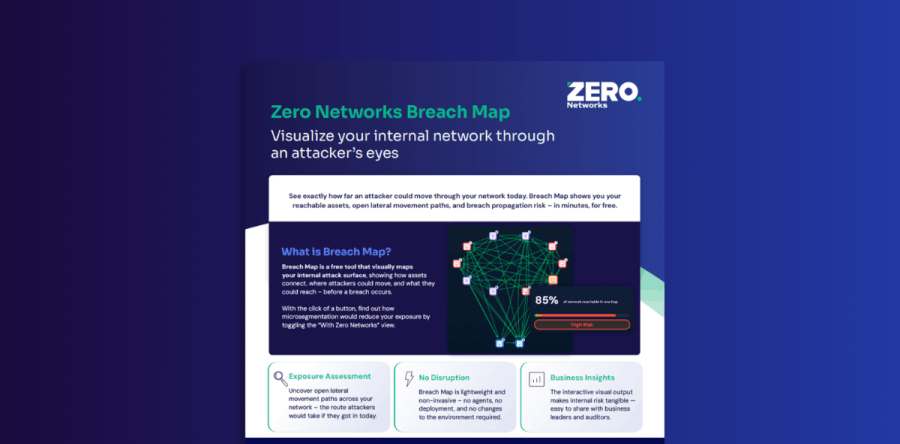
A single compromised endpoint can reach 85% of the environment directly.8 That reachability turns a minor cyber incident into a major business crisis before analysts investigate the first alert. Between incident response fire drills and operational disruptions, the cost of an uncontained breach can quickly stretch into the millions.
With Zero Networks:
- Every asset, identity, and AI agent is segmented automatically – including the service account the agent runs on and the egress path it needs – so breaches are contained to the initial point of compromise
- Network-layer MFA enforces just-in-time verification for all privileged internal pathways
- Uptime is protected; the business keeps running through attacks
See how Zero Networks optimizes security budgets with a built-in containment layer that cuts the cost of overlapping controls, consulting-heavy projects, and manual policy maintenance.
Sources
1 IBM, Capturing the Cybersecurity Dividend Study
2, 3, 4, 5 Zero Networks Customer Data
6 ESG Report, Technical Validation of the Zero Networks Platform
7 The Hidden Costs of Downtime Report 2026
8 Zero Networks, Threat Analysis: One Compromised System and BOOM, Meet Your Blast Radius
Related Content

- Network Security
November 03, 2026
M&A Cybersecurity: How to Shrink Inherited Attack Surface in Enterprise Networks

- Network Security
October 19, 2026
How to Secure Legacy Systems and Shrink Security Debt: Enterprise Guide to Protecting Complex Environments

- Network Security
October 16, 2026
What Is the OSI Model and Why Is It Important? Exploring the 7 Layers
- Network Security
September 04, 2026
AI Security Best Practices: How to Close AI Vulnerabilities with a Containment Architecture
- Network Security
August 14, 2026
The Kubernetes Rubik’s Cube: Solving Visibility, Governance, and Segmentation at Scale

- Network Security
August 11, 2026
Machine Identity Security: How to Protect Service Accounts and AI Agents
Trusted by


