What Is the OSI Model and Why Is It Important? Exploring the 7 Layers
Published October 28, 2025

Mikella Marley Content Marketing Manager

Every digital interaction relies on data traveling across multiple invisible layers. But without knowing how network communications function, security teams can’t effectively tailor protections. The OSI model solves this problem by providing a standard framework for understanding how systems communicate, enabling a structured and proactive approach to network security.
We’ll explore everything you need to know about the OSI model and each of its layers, how it compares to the Transmission Control Protocol/Internet Protocol (TCP/IP) model, and what it tells us about the importance of holistic security strategies.
Understanding the OSI Model: What Is It and Why Was It Developed?
The open systems interconnection (OSI) model was developed by the International Organization for Standardization (ISO) in the 1980s to standardize how systems communicate. It breaks network communication into seven distinct layers, from physical hardware at the bottom to user-facing applications at the top.
While today’s internet largely runs on the TCP/IP model, the OSI model remains the gold standard for designing and understanding networks, providing a universal standard for how communication should function.
Why the OSI Model Still Matters for Security Teams
The OSI model gives security teams a structured way to understand where and how attackers can exploit weak points across a network. By mapping defenses to OSI layers, organizations can:
- More precisely identify and contain attack surfaces
- Apply controls intelligently, aligning tools to the most effective layers
- Design defense-in-depth strategies that approach protection holistically
In other words, the OSI model helps security teams address the hidden relationships and dependencies that define how modern attacks unfold.
The 7 Layers of the OSI Model Explained
The OSI model divides network communication into seven abstract layers, each with distinct responsibilities. Data flows down on the sending device and back up with the receiver; each layer interacts with or interprets information as needed along the way.
For security teams, this layered structure helps map how defenses can (and should) be applied across the network. Understanding how OSI layers function – and how attackers commonly exploit them – emphasizes the importance of a holistic network security strategy.
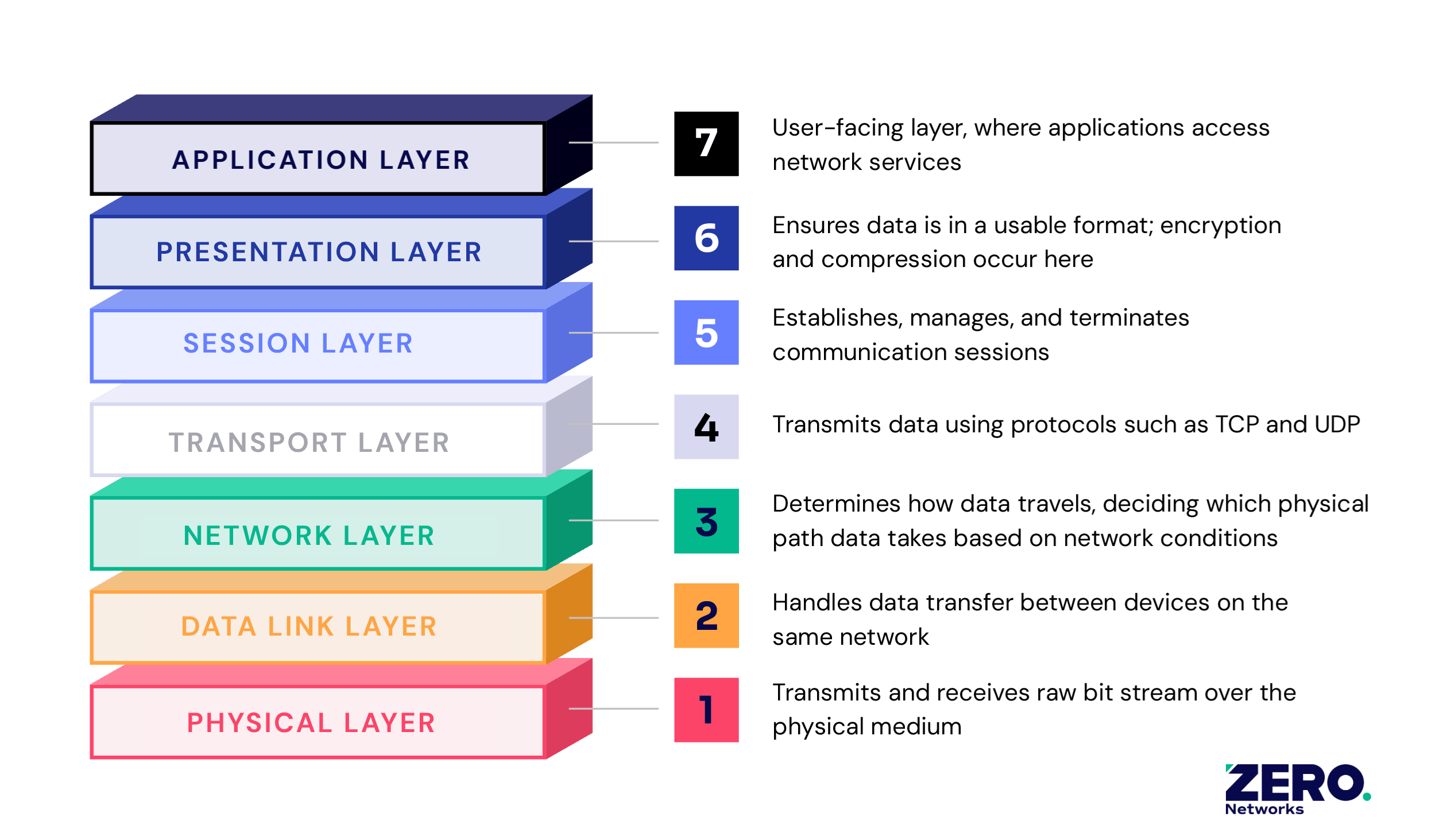 Layer 7: Application Layer
The Application Layer is the user-facing tier of the OSI model, where programs like web browsers, email clients, and APIs interact with the network. Layer 7 provides network services via protocols such as HTTP/S, FTP, DNS, and more. Because it’s closest to the end user, this layer is frequently targeted in modern cyberattacks.
Common Layer 7 threats include:
- Phishing and credential theft
- Web exploits, such as SQL injection or cross-site scripting (XSS)
- Certain distributed denial of services (DDoS) attacks
Layer 6: Presentation Layer
The Presentation Layer prepares data to be interpreted in the Application Layer or compressed for the Session Layer. It handles data formatting, compression, and encryption, ensuring that information from one system can be correctly interpreted by another.
For example, if data sent from one device uses an encoding method that the receiving device can’t understand, Layer 6 is responsible for translating the data into a different syntax. This layer is also where encryption and compression standards operate, ensuring the efficiency and security of communication.
Common Layer 6 threats include:
- Malware injection
- Protocol exploitation, leveraging vulnerabilities in protocols related to file sharing or remote desktop services
- Compression and encryption attacks
Layer 5: Session Layer
The Session Layer establishes, manages, and terminates communication sessions between assets. It coordinates dialogue, handling tasks like authentication, checkpointing, and reconnection in case of interruption. Protocols like RPC operate at Layer 5 of the OSI Model, illustrating how vital it is for modern operations.
Common Layer 5 threats include:
- Session hijacking
- Adversary-in-the-middle (AiTM) or attacker-in-the-middle attacks, which have risen 146% in the last year
- Replay attacks, reusing recorded session data to impersonate a valid user
Layer 4: Transport Layer
The Transport Layer ensures reliable end-to-end communication of data. It manages the segmentation, reassembly, error recovery, and flow control of data, using protocols such as TCP and UDP. Because it governs ports and connections, Layer 4 is often probed by attackers seeking open entry points.
Common Layer 4 threats include:
- Port scanning and enumeration to identify vulnerabilities for exploitation
- SYN flood attacks exploiting TCP handshakes
- UDP flood attacks, overwhelming the system with packets to cause service disruption
Layer 3: Network Layer
The Network Layer determines how data travels between devices across multiple networks. Data segments from the Transport Layer are broken into smaller units, called packets, at the Network Layer. This layer provides routing, forwarding, and addressing, determining the best path for data based on network conditions.
Layer 3 is central to most security operations – tools like firewalls, routers, intrusion detection systems, and more primarily function here.
Common Layer 3 threats include:
- IP spoofing and IP fragmentation attacks
- Routing attacks that misdirect traffic to a malicious target
- Volumetric DDoS attacks
Layer 2: Data Link Layer
The Data Link Layer enables communication between devices on the same network. Packets from the Network Layer are broken into frames in Layer 2 for flow and error control. Most switches operate at the Data Link Layer, with the exception of switches enabling communication between two networks or VLANs; in those cases, switches operate at Layer 3.
Common Layer 2 threats include:
- MAC spoofing, where the address of another device is forged to intercept its intended traffic
- VLAN hopping by exploiting misconfigurations
- ARP poisoning with falsified messages linking the attacker’s MAC address with the IP address of a legitimate network device
Layer 1: Physical Layer
The Physical Layer refers to the hardware that transmits raw binary data: cables, connectors, and the like. Layer 1 is also where data is converted into a bit stream, so it’s the point at which devices agree on a convention to distinguish ones from zeros. Though easily overlooked in cybersecurity conversations, the Physical Layer is the foundation of trust in every network.
Common Layer 1 threats include:
- Unauthorized devices connected to open network ports
- Cable tapping or signal interception
TCP/IP Model vs OSI Model
While commonly compared, the TCP/IP model and the OSI model differ in purpose, structure, and scope. Both models aim to clarify the flow of communication in a network, but OSI is a theoretical reference model while TCP/IP is a practical, protocol-based model.
In other words, the OSI model provides a standard for how network communication should work; the TCP/IP model outlines protocol-specific standards for how data is transmitted across the internet. Additionally, the TCP/IP model condenses several of the OSI model layers, taking a simplified four-layer approach.

OSI Layers and Identity Security: Application Layer MFA vs Network Layer MFA
Multi factor authentication (MFA) provides one clear example of how different levels of OSI alignment impact the effectiveness of security strategies. While MFA is essential for preventing identity-based attacks, not all solutions are created equal.
Application Layer MFA
Most MFA solutions operate at the Application Layer of the OSI Model, authenticating users before allowing access to an app or service. This strategy effectively protects SaaS applications and web portals, but it leaves privileged ports and protocols, legacy systems, and other non-SaaS assets operating below Layer 7 unprotected.
Network Layer MFA
By integrating MFA into the network infrastructure at Layer 3 of the OSI model, security teams enforce authentication long before a session reaches the application layer – directly at the point of access. Network layer MFA makes it possible to protect protocols like RDP, SMB, and SSH, keep privileged ports closed by default, and ensure just-in-time access is only granted temporarily.

Building Multi-Dimensional Network Protection
Modern cyberattacks rarely stay confined to one layer of the network – a single attack chain can easily span nearly every OSI layer. That’s why effective defense requires multi-dimensional, holistic protection across every axis of network traffic:
- North-South: Securing the perimeter against external access with firewalls and secure remote access solutions
- East-West: Preventing unauthorized lateral movement with granular microsegmentation
- Up-Down: Controlling access between layers to protect sensitive areas of the network with identity-based access controls
Zero Networks’ automated, identity-aware microsegmentation, combined with network layer MFA and Zero Trust network access, makes it easy for security teams to protect network communication at every critical juncture.
Find out how you can take a simple, comprehensive approach to network security – request a demo.