Advance Zero Trust Architecture with Fast, Automated Microsegmentation
Operationalize Zero Trust in weeks, not years. Automate policy creation, simulation, and enforcement to build a self-defending network architecture – no manual rule writing or network redesign required.

Zero Trust programs don’t have to stop after ZTNA.
Most organizations start by securing remote access. The next step extends Zero Trust inside the environment with segmentation. But complexity and outage risk keep internal networks broadly connected. Zero Networks removes those barriers with automated microsegmentation that turns Zero Trust strategy into enforcement in weeks, not years.

Unified Zero Trust enforcement
Network segmentation, identity segmentation, and secure remote access work together in a single, unified solution.

Deterministic automation accelerates AI-era protection
Zero Networks uses deterministic automation to create, simulate, and enforce policies automatically — no manual rule writing, consulting dependency, or multi-year implementation. As AI increases the speed of attacks and the complexity of environments, deterministic controls help organizations advance Zero Trust faster, safely, and with confidence.

Coverage that adapts as environments evolve
Policies dynamically adapt as the network changes, so your Zero Trust architecture won’t degrade over time.
Zero to the Rescue
Fast-Track Zero Trust
Full Zero Trust enforcement
Network segmentation, identity segmentation, and secure remote access work together to close east-west paths, govern every identity, and secure external connections with consistent least-privilege principles.
Automated least-privilege policy creation
Policies are automatically built from learned network behavior – no manual rule writing, consulting dependency, or implementation timeline standing between strategy and enforcement.
Identity-governed access, network-layer enforcement
Users, service accounts, machine identities, and AI agents are all subject to granular access controls enforced across the network – not just at login.
Zero Trust is operationalized in weeks, not years
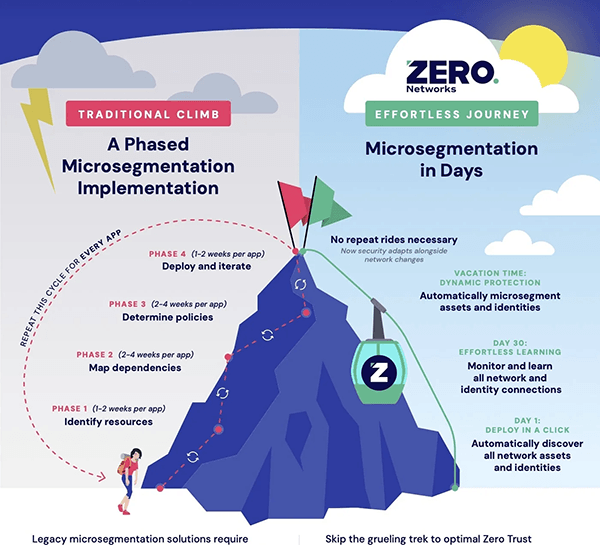
Automated, identity-driven microsegmentation deploys over existing infrastructure and segments 90%+ of the network within 90 days.
Remote access secured. Internal environment still open.
ZTNA locks down the edge, but the internal network remains broadly connected – leaving lateral movement paths wide open.
Manual effort keeps enforcement out of reach
Governing internal access manually requires years of policy creation, professional services dependency. Zero Trust programs get stuck after ZTNA.
Identities aren’t governed internally
You can control who gets in but not where they go once inside. Zero Trust principles end at the perimeter.
The Zero Trust roadmap never ends
Years of effort and investment, and the internal environment still remains broadly connected. The strategy exists on paper, but it’s not enforced in the architecture.
How it Works
A Layered Defense for True Zero Trust
Zero Trust requires more than locking down the perimeter. Zero Networks scales enforcement across all three dimensions of network traffic – protecting the boundary, locking down internal movement, and governing every identity.
Safeguard the Network Boundary with Secure Remote Access
Zero Networks secures every remote connection with Zero Trust principles – no open ports or broad internal trust extended to authenticated users, just verified access to specific resources only. VPN speed, ZTNA security.
Learn moreLock Down Lateral Movement with Microsegmentation
Internal pathways are closed by default. Granular, least-privilege policies are enforced across the environment, so compromises stay isolated. Containment is built into the architecture, not triggered after the fact.
Learn morePrevent Privilege Abuse with Identity-Aware Access Controls
Attackers rely on excessive permissions to expand breach impact. Zero Networks extends segmentation to the identities of users, devices, service accounts, and AI agents – restricting privileged access automatically.
Learn moreLearn More
Guide