Stop Lateral Movement
Before It Starts
Most enterprise networks were architected for connectivity, not containment. The same trusted pathways that keep the business running are the ones attackers use to move. Zero enforces least-privilege east-west access automatically — so a single compromised host stays exactly that.

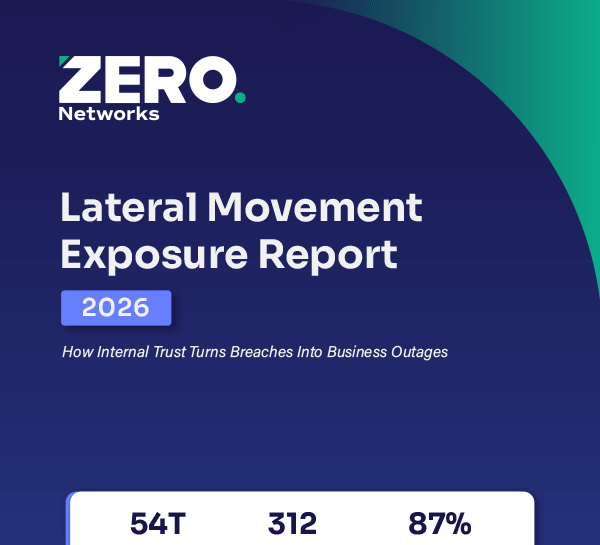
Lateral Movement
Most networks are built to connect everything. Attackers are counting on it.
Enterprise networks weren't built to contain breaches — they were built for connectivity. The same trusted protocols that keep operations running are the ones attackers use to move freely once they're inside. The data makes the exposure impossible to ignore.
How Zero Stops Lateral Movement
Lateral Movement Needs an Open Path. Zero Doesn't Leave Any.
Most architectures leave privileged paths open and wait for something to go wrong. Zero's automated network microsegmentation starts from the opposite position — every asset protected, every identity constrained, every privileged connection requiring explicit verification before it's permitted. Stolen credentials, compromised accounts, overprivileged service accounts — none of it translates into movement when there's no open path to move through. The result is a network that defends itself — automatically, continuously, and without waiting for an alert to fire.

Privileged Ports Closed by Default
RDP, SMB, SSH, WinRM — the protocols that account for 71% of all lateral movement activity — are blocked across every asset by default. Admins get temporary, time-bound access only after MFA verification at the network layer.

Having the Password Isn't the Same as Having Access
Zero applies identity segmentation and network-layer MFA to every privileged internal connection — so stolen credentials, compromised accounts, and overprivileged service accounts don't automatically translate into movement. With 43.2% of observed internal authentication still relying on NTLM, credential-based lateral movement remains the dominant attack pattern — and network-layer MFA is the control that makes it operationally useless. The credential gets you to the door. Zero doesn't open it.

Agentless, Automated, No Redesign Required
Zero learns actual communication patterns across every asset and builds least-privilege microsegmentation policies automatically — no agents, no manual rule-writing, no network redesign. It works over the infrastructure you already have, including legacy systems traditional tools can't reach. Average customers achieve 90%+ segmentation coverage within 90 days.

Built for AI-Speed Attacks
AI attack tools like Mythos and Daybreak don't move sequentially — they execute reconnaissance, credential abuse, and propagation in parallel across multiple targets simultaneously. From an attacker's perspective, an overprivileged agent is a service account that can be social-engineered — and AI makes that exploitation machine-speed. A closed-by-default architecture doesn't need to know the name of the next threat to contain it. When there are no open paths, attack speed stops mattering.
Zero to the rescue
Build a Network That Defends Itself
Privileged Paths are Closed by Default
RDP, SMB, SSH blocked across every asset. Temporary access granted only after network-layer MFA verification — and only to what's needed.
Credentials Alone Get Nowhere
Having the password isn't the same as having access. Every privileged connection requires identity segmentation and MFA at the network layer.
Containment Built Into the Architecture
Zero blocks lateral movement before detection has a chance to fire. The architecture contains by default — response speed stops being the only thing standing between a breach and a business outage.
Every Identity Governed Automatically
Service accounts, machine identities, and AI agents are subject to the same least-privilege controls as human users — automatically, from day one.
Privileged Paths Are Open
RDP, SMB, SSH broadly reachable by default. Any foothold inherits them.
Credentials = Access
A stolen password, compromised service account, or overprivileged agent translates directly into movement.
Detection-Dependent Defense
By the time an alert fires, the attacker has already moved. 27 seconds to break out. 241 days to contain.
Service Accounts and AI Agents Run Wild
Machine identities outnumber human identities 109:1 and most carry excessive standing permissions nobody is watching. AI agents are typically deployed with the credentials of high-trust service accounts — making them a high-value lateral movement target.
Learn More
Guide