Secure Legacy Infrastructure as You Modernize for Cloud, AI, and Beyond
Modernize infrastructure without exposing legacy systems. Zero Networks builds containment into your existing environment, reducing risk across legacy, cloud, and hybrid systems — without agents, network redesign, or downtime.
Make uptime nonnegotiable with comprehensive protection when modernization can’t wait.
Legacy-heavy enterprise environments get stuck in a common trap: too complex to secure with modern tools, too critical to leave exposed. Automated, identity-driven microsegmentation ends the tug-of-war between stronger security and operational continuity, delivering the protection you need without disruptions you can’t afford.

Protection without the re-architecture prerequisite
Agentless microsegmentation protects legacy systems from lateral movement without requiring network redesigns. Security doesn't wait on a multi-year infrastructure transformation to get started.

Granular control without breaking operations
Automated learning ensures policies are based on real network behavior. Validate rules in simulation mode before enforcing them for even more peace of mind.

Contain what you can't patch
Even systems that can't be updated or modernized are governed by identity-driven policies. An attacker can't exploit an unpatched legacy system to move laterally if there's nowhere to go.
Zero to the rescue
Legacy complexity, contained
Protection is layered on top of legacy systems
Agentless deployment means no compatibility concerns – legacy systems are governed by identity-driven policies using the existing infrastructure.
Apply MFA to privileged ports
Network-layer MFA can be enforced on legacy systems, databases, and other hard-to-protect assets.
Real-time network mapping
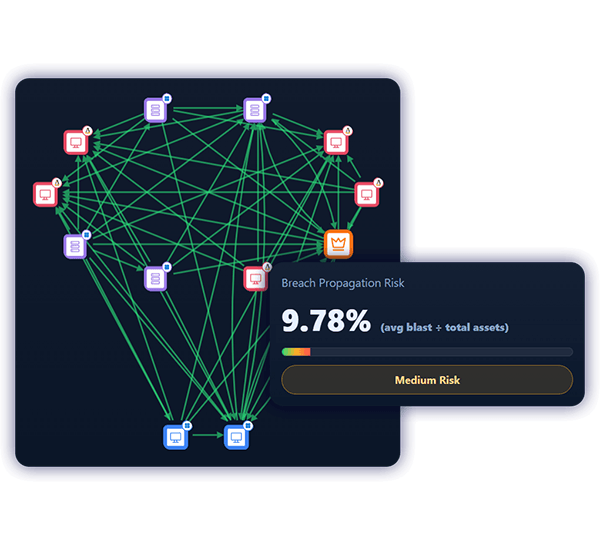
An always-current view of east west traffic across on-prem, cloud, IoT/OT, and Kubernetes delivers comprehensive visibility for confident control.
Validated control protects continuity
Zero Networks builds policies from real network behavior and simulates impact before rollout, so teams can reduce risk without forcing a trade-off between security and operations.
Legacy systems leave security gaps
Agents can't be deployed, patches can't be applied, and network redesigns can't be attempted without risking the operations that depend on them, leaving gaps attackers can exploit.
MFA only for layer 7 logins
Legacy applications with no native authentication support are exposed.
Limited east-west visibility increases operational risk
Internal traffic, dependencies, and accumulated access are often hard to see across hybrid environments, making it difficult to understand where the business is exposed.
Enforcement stalls when impact is unknown
Legacy systems are deeply embedded in business operations. Without a safe way to validate changes first, teams delay enforcement to avoid disrupting critical services — leaving exposure in place.
How Zero Networks secures enterprise networks
For organizations securing legacy and complex enterprise environments, here’s how Zero delivers vs. other microsegmentation vendors.
| Zero Networks |
Legacy Microsegmentation Vendors |
|
|---|---|---|
| Deployment model | Agentless — 1 virtual stateless appliance, no software installed on protected assets, deploys in 1 hour | Agent-based — requires installation on every workload, server, and endpoint; thousands of clients can take a long time to deploy |
| Legacy and unmanaged device support | Full protection without agents — covers systems that can't be patched, updated, or modified | Agent-based enforcement leaves legacy, unmanaged, and unpatched systems with monitoring-only coverage or no coverage at all |
| Network redesign required | No — works over existing infrastructure using native OS components (IPTables, WFP, ACLs, NFTables) | Often requires significant network redesign, VLAN restructuring, or hardware upgrades before deployment can begin |
| Time to full coverage | 90%+ of the network segmented within 90 days via automated policy creation | Manual, semi-automatic, and template-based approaches take months or years to achieve full network coverage |
| Policy creation | Automated — policies built from learned network behavior, no manual rule writing or asset tagging | Manual — requires active policy definition, asset tagging, and application dependency mapping by security teams; template-based policies require constant tuning |
| MFA at the network layer | Native just-in-time MFA enforced at every privileged port (RDP, RPC, SSH, WMI, SMB) — admin ports stay closed and open only temporarily after MFA verification | Not natively supported — admin ports must remain statically open for admin-related work, creating a persistent attack surface and recurring pen test findings |
| Performance impact | Not inline with traffic — negligible CPU and memory impact on protected systems | Inline solutions inevitably impact performance; agent memory usage can reach 500MB |
| Ongoing maintenance | Stateless server — nothing to update; automatically detects new devices and enforces least privilege policies as environments change | Agents are notorious for failing to upgrade (over 1%) and requiring manual troubleshooting; server updates are risky and required several times a year |
| Simulation before enforcement | Built in — every policy can be validated in simulation mode before going live | Varies by vendor; where available, requires manual configuration and review |
| Professional services dependency | None — no PS fees, transparent costs, easy to own and scale | Requires ongoing professional services to manage network changes and initial deployment, driving unpredictable, inflated costs |

"Zero Networks is a game changer. The military-grade security it delivers across segmentation, access, and user rights, makes it a new cornerstone technology."