The Kubernetes Rubik’s Cube: Solving Visibility, Governance, and Segmentation at Scale
Published August 14, 2026

Mohiit Dhawwan Customer Engineering
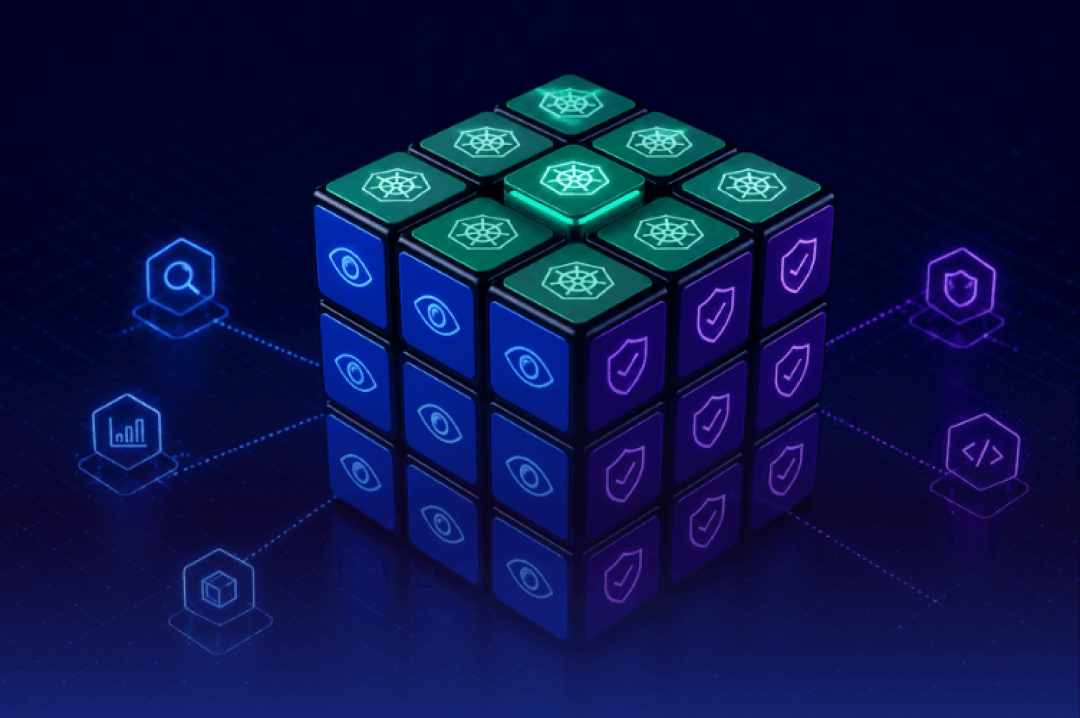
The K(C)ube
Almost everyone has picked up a Rubik's Cube at some point.
The first few moves feel productive. You line up a row of colours, complete part of a side, and convince yourself you're making progress. Then one more twist undoes everything you just achieved.
The challenge isn't that the cube is impossible to solve. The challenge is that every move affects something else.
Kubernetes environments often evolve in exactly the same way.
A cluster starts simple. A few workloads. A handful of namespaces. A small platform team that understands every application running inside it. Developers know what their services communicate with. Security teams understand the environment. Documentation is current. Dependencies are well known.
Then the business grows.
New applications are deployed. Additional teams adopt the platform. New services are integrated. More namespaces appear. More clusters are introduced. Temporary projects become permanent services. Acquisitions bring in new workloads. Migrations create new dependencies.
As the environment grows, responsibilities also begin to spread across application, platform and security teams. Each team makes decisions within its own part of the environment, but those decisions inevitably affect the others.
Before long, what started as a neatly organised environment begins to resemble a Rubik's Cube that has been twisted thousands of times.
Every team understands part of the environment. Few understand all of it.
Kubernetes Was Never Designed to Stay Small
One of Kubernetes' greatest strengths is its ability to scale rapidly.
Development teams can deploy applications faster than ever. New environments can be created in minutes. Infrastructure becomes highly dynamic and workloads are constantly changing.
But this flexibility introduces new challenges.
Unlike traditional environments where servers may exist for years, Kubernetes workloads can appear and disappear in seconds. Pods are ephemeral. Services communicate across namespaces. Applications are distributed across dozens or even hundreds of microservices. Workloads often communicate not only within a cluster, but across clusters and with external systems.
And it isn't just the technology that becomes distributed. Responsibility does too.
Application teams design the application, deploy it and increasingly define aspects of its networking and security. Platform and IT teams operate the underlying Kubernetes environment. Security teams remain responsible for governance, risk and ensuring that appropriate controls are in place.
The boundaries between these responsibilities are not always clear.
If a privileged pod introduces unnecessary risk, who owns the problem? Is it an application issue, a platform configuration issue or a gap in security policy? If a new service introduces an unexpected communication path, who is responsible for identifying it and deciding whether that access should exist?
As environments grow and development teams move faster, these questions become increasingly difficult to answer. Security teams may be accountable for protecting the environment without having complete visibility into how applications are changing or communicating. Platform teams understand the infrastructure, while application teams often have the deepest understanding of individual workload dependencies.
Each team understands a different part of the cube.
Questions that were once simple become surprisingly hard to answer:
- Which services communicate with each other?
- Which communications are business critical?
- Which namespaces should never communicate?
- Which connections were introduced for testing and never removed?
- What would happen if access was restricted?
- Who owns the risk when unnecessary access is discovered?
In many organisations, nobody can confidently answer all of these questions.
This isn't necessarily a failure of technology or process. It is the reality of operating a modern Kubernetes environment at scale, where the environment can change faster than teams can collectively understand it.
Complexity accumulates faster than understanding.
The Cost of Not Knowing
Most platform and security teams understand the value of segmentation.
Yet many Kubernetes segmentation initiatives never move beyond planning. Why?
Because nobody wants to break production.
Imagine being asked to implement restrictive Network Policies across a cluster containing hundreds of applications and thousands of workloads.
Before creating a single policy, you need to understand what traffic is required, what traffic is optional, what traffic is legacy and what traffic represents unnecessary risk.
That understanding is rarely owned by a single team. Application teams understand their services and dependencies. Platform teams understand the infrastructure. Security teams understand the risk and controls.
Without that understanding, every policy becomes a gamble.
Block the wrong communication path and a customer-facing application may fail. Restrict access incorrectly and a business-critical service may stop functioning. The operational consequences often feel more immediate than the security risks.
As a result, organisations frequently choose the safest operational option.
They leave access open.
The business impact of this decision is significant. Excessive connectivity increases attack surface, expands blast radius during incidents, complicates compliance efforts, and makes investigations substantially more difficult. Security teams understand the risk, but reducing that risk often appears riskier than accepting it.
The organisation becomes trapped between security and operational certainty.
Why Native Kubernetes Controls Aren't Enough
Kubernetes provides Network Policies that allow organisations to control communication between workloads. The concept is powerful.
The implementation is often challenging.
In smaller environments, manually managing Network Policies may be achievable. In larger environments, the reality becomes much more complicated.
Different teams create policies. Applications evolve. New services are deployed. Existing services are modified. Documentation becomes outdated. New namespaces and workloads appear. Clusters grow. Additional clusters are added.
The challenge is that Kubernetes environments never stay still. Development teams continuously ship changes, often at a pace that security teams cannot manually review. A cluster may initially align with CIS Benchmarks or an organisation's internal security baseline, but as new workloads, configurations and communication paths are introduced, the environment can gradually drift away from that intended state.
This configuration drift is rarely the result of a single major change. It accumulates over time as applications evolve, teams move quickly and exceptions are introduced. At scale, maintaining consistent policy enforcement becomes just as challenging as defining the policies in the first place.
Over time, organisations accumulate hundreds or even thousands of policy definitions spread across namespaces and environments. Policies that were appropriate when they were created may no longer reflect how applications operate today.
The challenge isn't creating policies.
The challenge is understanding whether those policies accurately reflect how applications should communicate and ensuring they continue to do so as the environment changes.
Most teams can view individual policies.
Few teams can easily understand the cumulative impact of all policies across the environment, identify where configuration drift has occurred, or determine whether new communication paths have introduced unnecessary exposure.
Without visibility, organisations are effectively trying to solve a Rubik's Cube while only seeing one side.
What Happens When a Workload Is Compromised?
Security teams invest significant effort into preventing compromise.
Clusters are protected by vulnerability scanners, image scanning solutions, admission controllers, runtime protection platforms, secrets management solutions and RBAC controls. These technologies are essential and form a critical part of a defence-in-depth strategy.
However, no organisation can guarantee that a workload will never be compromised.
The more important question is what happens next.
Imagine a single workload becomes compromised. Not the entire cluster. Not a cluster administrator account.
Just one pod.
What can it reach?
- Can it communicate with other workloads in the same namespace?
- Can it access services in another namespace?
- Can it discover internal APIs?
- Can it reach backend databases?
- Can it communicate with management services or infrastructure components?
For many organisations, the answer is unclear.
By default, Kubernetes environments can provide significantly more connectivity than teams realise. Over time, communication paths accumulate. Some are necessary. Others exist because of historical decisions, temporary exceptions, inherited configurations, or simply because nobody wanted to risk breaking an application.
An attacker doesn't necessarily need cluster-admin privileges to cause damage.
They need a path to something valuable.
Once an attacker gains access to a workload, trusted east-west communication paths can allow them to discover internal services, communicate across namespaces, access backend APIs, interact with databases or explore management components within the environment.
This is where a contained compromise can become a much broader incident.
A workload that should have been isolated can become a launchpad for lateral movement. Sensitive services that were never intended to communicate may become accessible. Databases, internal APIs and critical business systems can all become part of the attack path.
The challenge isn't simply that these communication paths exist.
The challenge is knowing which ones should exist.
Without visibility into workload-to-workload communication, it becomes extremely difficult to distinguish legitimate business traffic from unnecessary exposure.
The risk isn't necessarily the compromised workload.
The risk is everything connected to it.
Before organisations can reduce lateral movement, they first need to understand it.
Seeing the Whole Cube
The turning point occurs when the environment becomes visible.
Most Kubernetes tools provide visibility into individual components. Teams can inspect pods, deployments, services, logs and policies. While each of these views is valuable, they rarely provide a complete understanding of how the environment functions as a whole.
This is similar to studying a Rubik's Cube one square at a time. You can understand individual pieces without understanding how they relate to each other.
As Kubernetes environments grow, those relationships become increasingly important.
Security teams need to understand which namespaces communicate with each other. Which communication paths are unrestricted. Which workloads are isolated. Which areas of the environment have no policy enforcement. Which connections are expected and which represent unnecessary exposure.
But visibility also needs to be shared.
Application teams understand how their applications are designed. Platform teams understand how the Kubernetes environment operates. Security teams understand the organisation's risk and governance requirements. Giving these teams a common view of communication, access and policy helps turn fragmented knowledge into coordinated decision-making.
This is where the Zero Networks Kubernetes Access Matrix becomes valuable.
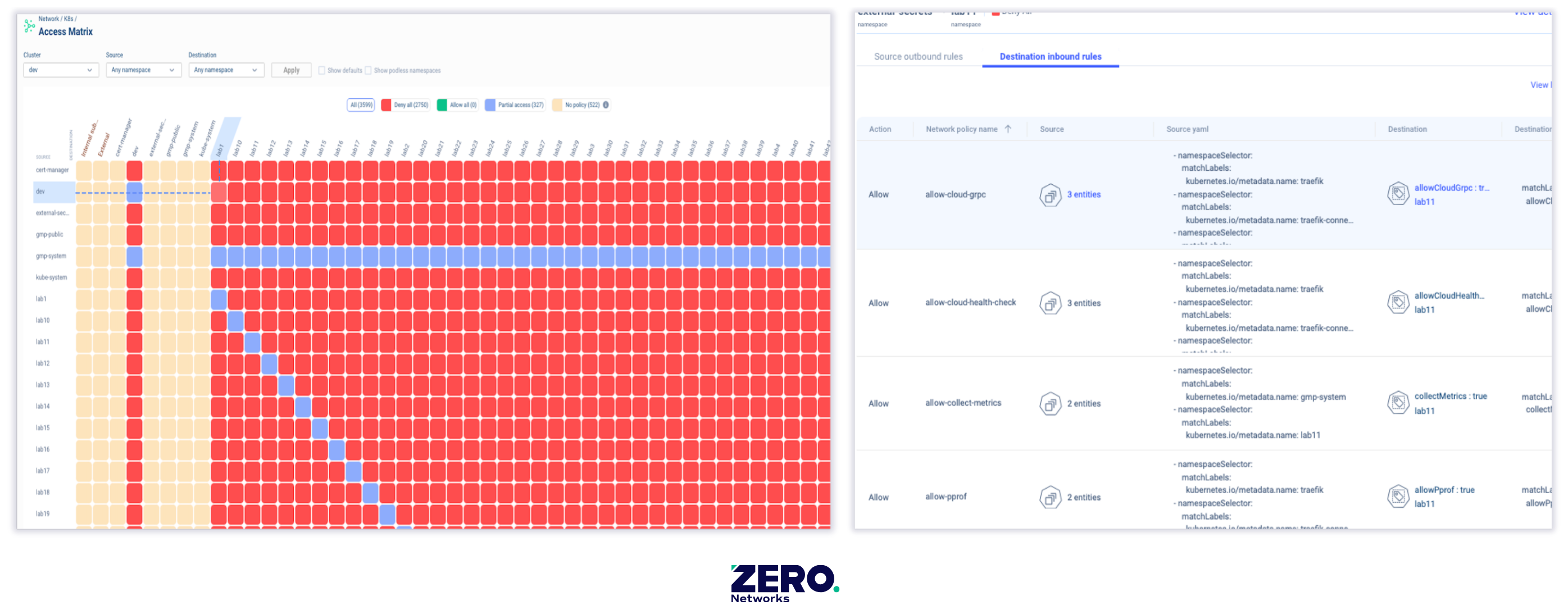 Rather than analysing workloads and policies individually, the Access Matrix provides a visual representation of communication and policy enforcement across the cluster. Teams can identify unrestricted communication paths, isolated namespaces, partially restricted access and areas where no policies exist at all.
Combined with visibility into actual data flows and the existing rule baseline, teams can begin identifying where access is required, where it may be excessive and where ownership or policy decisions are needed.
What previously required teams to piece together information from multiple views becomes visible in a single place. More importantly, the conversation changes.
Teams stop asking: "What happens if we block this?" And start asking: "Why are we allowing this?"
Visibility transforms security from guesswork into decision-making.
And, just as importantly, it gives Application, Platform, and Security teams a common view from which to make those decisions together.
Solving the Cube Layer by Layer
Nobody solves a Rubik's Cube by looking at it once and immediately making the perfect move.
They start by understanding the current state of the puzzle. Only then can they begin making deliberate decisions that move them closer to the end goal.
Kubernetes security follows a similar journey.
The first challenge is understanding how workloads communicate. Which namespaces talk to each other? Which connections are required? Which exist purely because they were never removed? Which could become attack paths if a workload is compromised?
Without those answers, implementing segmentation becomes difficult and potentially disruptive.
This is where Zero Networks starts.
Using eBPF-based monitoring, workload communication is automatically discovered and mapped across the cluster. The Kubernetes Access Matrix provides a clear view of namespace-to-namespace relationships, helping teams understand how applications actually communicate rather than relying on outdated documentation or assumptions.
Once communication becomes visible, organisations can begin making informed security decisions.
Instead of attempting to segment the entire environment at once, teams can progressively introduce least-privilege controls using Kubernetes-native Network Policies. Existing policies can be synchronised from Kubernetes into Zero Networks, giving Security and Platform teams a central view of the policies already defined across the environment.
Policies can then be reviewed and approved within Zero Networks before enforcement, adding a governance layer around Kubernetes-native controls. This allows application teams to continue defining the policies their applications require, while giving Security and Platform teams the oversight needed to ensure those policies align with the organisation's security requirements.
Where appropriate, policies can also be automatically enforced by Zero Networks, reducing the operational effort required to implement and maintain segmentation at scale.
This becomes particularly important as Kubernetes environments continue to change. New workloads, namespaces and communication paths are constantly introduced, making it difficult for Security teams to manually keep policies aligned with the environment.
With automated learning capabilities being introduced, Zero Networks can take this further by learning how workloads communicate and helping create policies based on observed behaviour. Combined with automated enforcement, this can help security controls keep pace as applications and Kubernetes environments evolve.
The result is a Kubernetes environment that looks very different from where it started.
What was once a flat environment with unclear communication paths becomes an environment where connectivity is understood, governed and intentionally controlled.
Attack surface is reduced. Lateral movement opportunities are limited.
And perhaps most importantly, application, platform and security teams gain a common framework for improving security without unnecessarily slowing development or risking disruption to production.
Just like solving a Rubik's Cube, success doesn't come from making more moves.
It comes from understanding the puzzle, making the right move and continuing to adapt as the puzzle changes.
Final Thoughts
The challenge with a Rubik's Cube isn't that it's impossible to solve.
The challenge is understanding how every piece relates to every other piece.
Kubernetes environments present a remarkably similar problem. As clusters grow, complexity accumulates faster than understanding. Communication paths multiply, applications continuously change and responsibility becomes distributed across Application, Platform and Security teams.
Most organisations don't struggle because Kubernetes lacks security controls. Kubernetes already provides powerful capabilities such as Network Policies. The challenge is maintaining visibility and governance as the environment evolves — understanding what should be allowed, what can be restricted and how policies can be consistently enforced without disrupting business operations.
Zero Networks provides the visibility and governance layer that helps bring those pieces together. By providing a shared understanding of workload communication and Kubernetes-native policies, teams can identify unnecessary exposure, coordinate policy decisions and progressively enforce least-privilege segmentation at scale.
The goal isn't simply to solve the cube once.
It's to keep it solved as the environment continues to change.