From Flat to Segmented: Baking Security into Your K8s Environment
Published August 27, 2025

Arik Diamant Product Marketing Manager

Kubernetes is rapidly becoming a platform of choice for many enterprises. CNCF reports that over 80% of organizations are already using it in production, and numbers continue to rise. But alongside the power of K8s to automate, manage, and scale application deployment lie its share of security risks and challenges.
According to the State of Kubernetes report 2024, 9 out of 10 companies report a cluster or container breach in the past year. As most clusters are flat by default, once an attacker gains foothold in the cluster they are free to move laterally and escalate their attack vector. According to the report, 46% of respondents identified revenue or customer loss as a result of a container and Kubernetes security incident. Kaspersky’s survey from the same year further validates these statistics.
The Challenges in Securing K8s: Inconsistent Network Policies, Blind Spots, and Beyond
Kubernetes security is hard to manage. Unlike physical networks with persistent IP addresses, K8s workloads are ephemeral, dynamic, and rely on labels and NAT for routing. In such environments, meaningful visibility into network traffic is difficult to achieve. DevSecOps teams and security architects have grown accustomed to this blind spot – but it’s not just inconvenient, it’s dangerous. Without insight into service-to-service communication, threats can propagate unchecked, policies can drift or misalign, and malicious activity can persist undetected until it's too late to contain.
Furthermore, Kubernetes network policies are often a patchwork of fragmented rules – written by different teams, using inconsistent logic, and lacking any centralized oversight. When a new app is deployed into K8s, the app owner typically adds another YAML-based rule set into the mix through the CI/CD pipeline. Security architects either review the policies app-by-app, or often don’t view them at all, lacking the means to place them in a broad context or to apply more general policies of their own across applications.
Worse still, when K8s workloads need to communicate outside their cluster – to other clusters or on-prem data centers – security becomes fuzzy, and architects need to guess their way through the noise, often leaving networks exposed to breaches.
Native, Unified, Non-Intrusive: How Zero Networks Secures Kubernetes
Zero Networks delivers enterprise-grade Kubernetes network security that’s built for scale, bringing order, visibility, and control without slowing down DevOps.
Full Visibility into K8s Clusters
Workloads deployed and internal/external traffic that used to be invisible are now visualized accurately and conveniently, enabling teams understand and govern their K8s landscape and see exactly which workload is communicating with which.
Unified Governance
Zero Networks provides a paradigm shift in K8s security by unifying network controls across clusters and environments. The Zero Networks interface is a single, always-up-to-date source of truth that governs network communication inside K8s clusters and across clusters, as well as other deployments such as bare metal servers, VMs, and more.
Zero grants app owners the freedom to push network policies through the CD pipeline as often as needed, detecting the policies uploaded as YAML and translating them into Zero Networks rules.
In addition, DevSecOps can create network policies through the user-friendly Zero Networks interface.
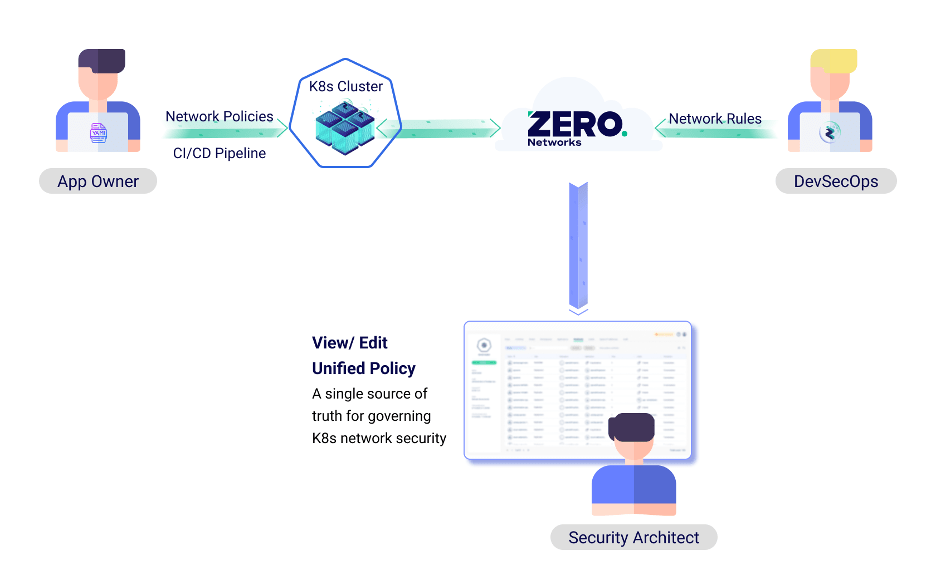
Whichever the source of the policy, it is immediately reflected in the unified Zero Networks rule view. The security architect is free to approve the new policy, to edit it or to add new rules altogether, transforming K8s policy management from a guessing game into hard science.
Non-Intrusive
Zero’s solution is non-intrusive by design, using eBPF to monitor network activity with minimal performance impact and the native Kubernetes Network Policies for microsegmentation. When enforced by the CNI, these policies enable isolating workloads and restricting communication between different applications or namespaces, thereby reducing the attack surface, preventing lateral movement and containing potential security breaches.
Using these native tools means Kubernetes workloads start secure, with least-privilege permissions from the moment they launch — and are free to scale seamlessly and securely, exactly as Kubernetes was meant to operate.
1-min Deployment
A single helm statement deploys Zero Networks into your cluster. Within minutes, you’ll gain full visibility into cluster entities and their communication patterns.
K8s Compliance
With Zero Networks, security teams gain the visibility and control needed to satisfy auditors and prove compliance with standards like PCI-DSS, HIPAA, NIST, and more.
Easy-to-understand least-privilege policies, unified audit trails, and real-time enforcement make it easy to demonstrate continuous compliance and quickly adapt to regulatory demands across hybrid environments.
Take Your Kubernetes Environment from Flat to Secure in Days—Not Months
Zero Networks allows you to discover what is deployed, visualize the internal and external communication and natively enforce microsegmentation to all K8s assets while conforming to industry best practices.
With Zero Networks, Kubernetes clusters go from wide-open to least-privilege in days, ensuring they stay fast and agile for the business – while impenetrable for attackers. Request a demo to learn more.