How to Enforce MFA for RDP and Privileged Access: Containing AI-Powered Attacks
Published October 26, 2026

Mikella Marley Content Marketing Manager

Frontier AI models can find and weaponize software vulnerabilities faster than any patch cycle was built to handle, and AI-enabled adversaries can move laterally through trusted internal access paths before detection-and-response workflows are meaningfully underway. In fact, attacks by AI-enabled adversaries are up 89% year over year; according to Unit 42’s 2026 Global Incident Response Report, these AI-assisted attacks can go from initial access to data exfiltration in just 72 minutes – 4x faster than the previous year.
While the speed of AI-powered cyberattacks is new, the tactics are familiar. Zero Networks’ 2026 Lateral Movement Exposure Report found that 71% of enterprise threat activity flows through just four admin protocols, and 87% of servers accept internal RDP or SSH traffic. So, containing AI-driven attacks doesn’t require faster detection or patching – it requires keeping the pathways adversaries rely on closed by default.
We’ll walk through how AI-powered attacks leverage open privileged pathways, why enforcing network-layer MFA is key for containing AI-speed attacks, and what it takes to protect admin ports, sensitive systems, and critical services without adding operational friction.
Key Answers
- How do AI-enabled attackers use admin protocols? Over 70% of threat activity flows through RDP, SMB, WinRM, and RPC; AI-driven lateral movement moves through those open pathways at machine speed, enabling attackers to escalate privileges and reach critical systems without triggering alerts.
- How can security teams enforce MFA for RDP and other admin protocols? Network-layer MFA operates at Layer 3 of the OSI model, while traditional MFA operates at Layer 7. Enforcing just-in-time verification at Layer 3 allows security teams to keep privileged internal pathways closed by default, opening only for pre-approved identities for a limited window.
- What are best practices for containing AI-speed attacks? Implement identity-based microsegmentation to establish a closed-by-default baseline that leaves no room for AI-driven lateral movement – regardless of how quickly attackers move. Then, enforce MFA on admin ports, privileged logons, and sensitive systems to close any remaining gaps attackers might exploit, while allowing legitimate traffic to flow freely. Use deterministic automation to adapt access policies as the network changes, ensuring security scales with the business.
- How do I know if I’m prepared to absorb AI attacks? The most dependable measure of resilience against AI threats is closed-by-default architecture that proactively limits the spread of an attack, making speed irrelevant. Take Zero Networks’ AI Readiness Assessment for a customized report on your organization’s ability to contain AI attacks architecturally.
How AI-Powered Attacks Target Admin Protocols
AI-assisted attackers can conduct reconnaissance, escalate privileges, and move laterally in parallel across hundreds of targets, enabling them to find a way into and through the network at unprecedented speed and scale.
AI-Driven Vulnerability Discovery and Lateral Movement
Attackers’ weaponization of advanced AI increases the odds that flaws are found and exploited quickly. According to Mandiant’s 2026 M-Trends report, exploitation of vulnerabilities already ranks as the #1 initial access vector, and mean time to exploit is -7 days, meaning vulnerability exploitation typically happens before a patch exists.
While a vulnerability exploit may give attackers an initial foothold, open privileged pathways expand their reach. Over 70% of threat activity flows through RDP, SMB, WinRM, and RPC. Because they function as high-trust highways for IT operations, these protocols often stay open by default – and attackers know it.
From an initial point of compromise, attackers can simultaneously explore and exploit multiple pathways with AI-driven lateral movement (AILM). And critically, AI-enabled attackers are exploiting the same pathways they always have, just far faster and more effectively. Statically open admin protocols and standing privileged access give attackers the broad internal reachability to turn a minor compromise into a business crisis.
Closing Privileged Pathways: Just-in-Time Access with Network-Layer MFA
Traditional MFA operates at Layer 7 of the OSI model – the application level. While this strategy effectively protects SaaS applications and web portals, it leaves privileged ports and protocols, legacy systems, and other non-SaaS assets operating below Layer 7 unprotected. In other words, most MFA governs authentication at the entry point into an application without determining what happens inside the network, after initial access.
To effectively close the privileged internal pathways that attackers use to escalate breaches at AI speed – without impacting critical operations – enterprises need to enforce MFA at Layer 3 of the OSI model (the network layer). Network-layer MFA triggers verification directly at the point of access, long before a session reaches the application layer.
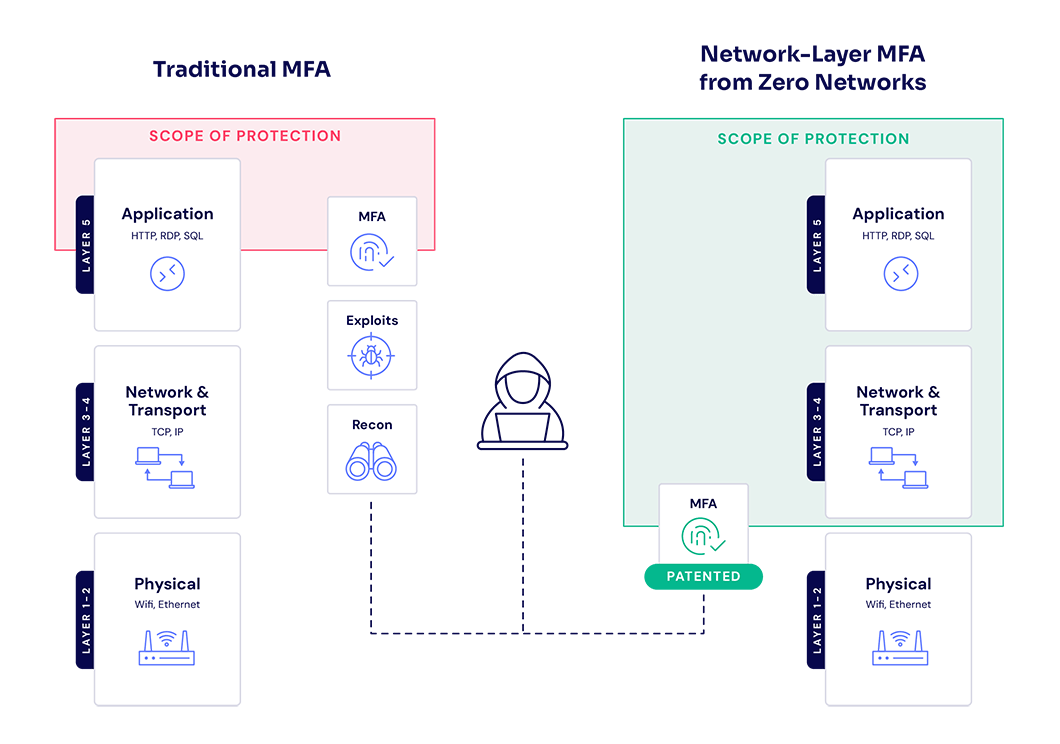
Practically speaking, this approach means security teams can:
- Close admin ports before AI can reach them: RDP, SSH, SMB, WinRM, and RPC stay closed by default, only accessible to pre-approved identities after MFA verification – and only for a limited window.
- Reinforce network- and identity-based controls: Microsegmentation and identity-based access controls provide a proactive containment layer for AI attacks, delivering baseline protection; adding network-layer MFA to sensitive protocols and privileged access further strengthens that posture, removing all opportunities for AI-driven lateral movement.
- Secure privileged access without disrupting critical workflows: By removing the forced trade-off between stronger security and operational continuity, network-layer MFA keeps sensitive ports and protocols closed to unauthorized identities without adding friction to legitimate operations by enabling just-in-time access.
How to Enforce MFA on Admin Ports and Privileged Access: Best Practices for Blocking AI-Speed Attacks
Network-layer MFA is an important part of a closed-by-default architecture. Identity-based microsegmentation defines which systems can communicate and who can access those pathways; network-layer MFA ensures that particularly sensitive pathways only open for pre-approved identities for a limited time when necessary. Together, these strategies contain AI-driven attacks by design – regardless of where they start or how quickly they move.
Build a Proactive Containment Layer with Identity-Based Microsegmentation
Start by mapping every network asset and establishing a baseline for how systems and identities communicate. Those insights enable security teams to proactively isolate assets and build granular access policies tied to identity, establishing a closed-by-default baseline that prevents lateral movement without impacting operations.
How this contains AI-driven attacks
AI-driven reconnaissance maps every reachable system from a given foothold in parallel. A closed-by-default architecture drastically shortens that list, keeping all assets without a verified business need structurally isolated by default. To see your attack surface through an attacker’s eyes, use Zero’s free Breach Map tool →
Enforce Network-Layer MFA on Admin Protocols and Privileged Access
Identity-based microsegmentation defines which users are allowed to access sensitive ports; network-layer MFA enforces those rules as just-in-time access decisions. Admin protocols remain closed by default, but pre-approved identities with a legitimate business need can gain time-bound access after completing verification, making MFA for RDP, SSH, and WinRM operationally feasible. Similarly, network-layer MFA can secure all privileged logons for users that require elevated permissions, prompting users to complete verification before gaining access to pre-approved assets only.
How this contains AI-driven attacks
After gaining initial access, AI-enabled attackers seek out privilege escalation opportunities, riding trusted access paths to critical assets without triggering alarms. With admin ports and privileged logons closed until MFA verification, stolen credentials are just another dead end.
Dynamically Adapt Access Policies with Deterministic Automation
Maintain continuous visibility into internal communications and use those real-time insights to power a deterministic automation engine that adapts and enforces policies as the network evolves.
How this contains AI-driven attacks
Attackers weaponize AI to exploit new paths as soon as they appear. In dynamic networks, deterministic automation is the only way to ensure security gaps never accumulate, leaving no room for AI-driven attacks to spread.
Proactively Contain AI-Driven Attacks with Zero Networks
With identity-based microsegmentation, Zero Networks automatically segments every asset, identity, and AI agent, so when a breach occurs, it stays isolated.
Zero automatically enforces adaptive, identity-aligned policies based on real network behavior. By tightly coupling network and identity enforcement and adding just-in-time MFA verification to privileged access, Zero protects protocols like SMB, RDP, WinRM, and RPC without disrupting operations.
Learn more about how you can build a cyber resilient architecture designed to contain AI-speed attacks – request a demo.