Vulnerability Management in the Frontier AI Era: How to Proactively Stop Exploitation
Published August 13, 2026

Mikella Marley Content Marketing Manager

Vulnerability exploitation now ranks as the #1 way attackers gain access to networks, according to leading industry reports – Mandiant’s 2026 M-Trends report attributes 32% of initial infections to exploits, while exploitation of vulnerabilities similarly accounts for initial access in 31% of breaches investigated for Verizon’s 2026 DBIR, a 55% increase year-over-year.
The timing of this trend directly coincides with the rise of frontier AI models like Mythos and Daybreak, which represent a growing class of AI-driven vulnerability research tools capable of finding, analyzing, and generating exploits for vulnerabilities at a speed and scale no human team can match – a development that led Open AI to call on CISOs to implement network segmentation.
IBM’s 2026 Cost of a Data Breach report spells out the financial weight behind this rise in machine-speed vulnerability exploitation: AI-driven attacks add an average of $1 million to the cost of a breach as new velocity and scale reshape the economics of cyber incidents.
When patches are released at an impossible volume, the window between vulnerability discovery and exploit shrinks to nothing, and security teams face mounting pressure to protect uptime. In response, enterprises need to fundamentally rethink vulnerability management, prioritizing proactive containment rather than faster patching.
Key Answers
- What are the latest trends in vulnerability management? Vulnerability management is shifting from patch-speed to containment-first strategies. Frontier AI models like Mythos and Daybreak have compressed discovery-to-exploit timelines beyond what patch management cycles can match, making proactive containment a key defense.
- Are there any new tools or techniques for vulnerability mitigation? Security teams can build a standing protection layer that limits what an exploited asset can reach with identity-based microsegmentation, buying more time to test and validate patches before deploying them without leaving the business exposed to critical vulnerabilities in the interim. Tools like Zero Networks' Breach Map help identify exposure and uncover targeted opportunities for mitigating a vulnerability.
- How can enterprises manage the rise in discovered vulnerabilities and patches driven by frontier AI models? Security teams can't realistically test and validate every patch fast enough to keep up with frontier AI-driven discovery volume. Rather than rushing unvalidated fixes into production, enterprises should close unnecessary access paths by default, rely on identity-based microsegmentation to buy the time needed to patch safely, and prioritize remediation based on reachability.
- What are some best practices for proactively defending against vulnerabilities? Measure blast radius to prioritize business exposure over CVSS severity alone, close unnecessary access paths by default with microsegmentation, apply targeted access rules to buy time while a patch is tested, and ensure containment is enforced architecturally so protection doesn't depend on detecting an exploit first.
What Is Vulnerability Management?
Vulnerability management is the ongoing practice of identifying, assessing, resolving, and verifying fixes for security weaknesses across an environment.
Continuous vulnerability management is one of 18 critical security controls included in the Center for Internet Security (CIS) Cybersecurity Framework – in theory, an always-on cycle of vulnerability scanning, assessment, and remediation enables organizations to remediate vulnerabilities before they can be exploited. However, AI-driven attacks have challenged the assumptions that underpin traditional vulnerability management cycles.
The Vulnerability Management Lifecycle
Some vulnerabilities pose a greater threat than others. The vulnerability management lifecycle is meant to help organizations catch and fix the most urgent problems – it typically revolves around four core stages:
- Identify: Continuous scanning and asset discovery keep a network map up to date, enabling security teams to effectively identify assets that could be impacted by known and newly disclosed vulnerabilities.
- Assess and prioritize: Security teams score vulnerabilities by severity (often using the Common Vulnerability Scoring System [CVSS]), exploitability, and business context to determine what needs attention first.
- Resolve: The most common approach to resolving a vulnerability is remediation, often achieved by applying a patch. But in some cases, a patch isn’t yet available or can’t be applied without risking disruption. When full remediation isn’t possible, organizations may resolve a vulnerability through mitigation – applying controls that make the vulnerability significantly harder to exploit or minimize the impact of exploitation, even if the vulnerability technically still exists.
- Verify: Whether the vulnerability is fully remediated or mitigated, teams confirm the fix closed the exposure to the greatest extent possible without introducing new risk or breaking dependent systems.
How Patch Management Works
Patching is a tried-and-true staple in vulnerability remediation. Until now, patch management has followed a predictable cycle: a vendor discloses a vulnerability and it’s assigned a CVE, the vendor issues a security patch, and organizations test the patch before deploying it into production. Testing is a critical step in the cycle – an unvalidated fix can break critical connections and disrupt operations. Once testing clears, the patches are typically deployed on a scheduled cadence, such as Microsoft's monthly Patch Tuesday; the team verifies the fix afterward.
This cycle was built on the assumption that the time between a vulnerability's discovery and its mass exploitation would be measured in weeks or months, giving defenders room to test patches safely before deploying. But that timeline has collapsed in the wake of frontier AI models such as Mythos and Daybreak.
“The announcement in April 2026 of a frontier model that managed to find thousands of high-severity vulnerabilities—including some in every major operating system and web browser—is a signal warning to security teams … In the hands of attackers, these tools will collapse the time between vulnerability discovery and exploitation. Attackers are abandoning human speed for machine speed.”
IBM, 2026 Cost of a Data Breach Report
Why Frontier AI Broke the Traditional Patch Management Model
Even before AI-enabled discovery and exploitation upended the threat landscape, security teams were struggling to keep up with patching – and the data proves it. Now, as attackers increasingly weaponize AI, traditional patch management workflows are an untenable solution.
| Report | Key Findings | What It Means |
|---|---|---|
| Verizon 2026 Data Breach Investigations Report |
|
Security teams have been struggling to keep up since before frontier AI models triggered a patch avalanche, leaving critical gaps uncovered. |
| Mandiant M-Trends Report 2026 |
|
The average vulnerability is now exploited before a patch is generated. |
| IBM 2026 Cost of a Data Breach Report |
|
Even AI tools intended to support defenders run the risk of weaponization as attackers have so far advanced in the “AI arms race.” |
So, the rapid acceleration in vulnerability discovery is forcing already strained patch management cycles to a breaking point. For example, Microsoft released its largest Patch Tuesday ever in July of 2026: 570 fixes, including three zero-day vulnerabilities – in total, a more than 3x increase since April.
The practical impact for defenders that continue to rely on patching as their core vulnerability management strategy is a forced tradeoff: you can patch immediately and manage updates that contain thousands of fixes at a time, or wait and validate the highest priority patches while accepting risk exposure in the interim. In either case, operational continuity is at risk.
“We cannot patch Mythos or Daybreak away. Discovery is infinite now. We can find thousands or even millions of new vulnerabilities every day. And the patching time we have is finite – it's impossible to digest all those patches, validate that a new patch isn't generating a business impact, and move fast enough. Even with prioritization, it will always be late. Because the time AI needs to generate an exploit will always be faster than the time you need to prioritize, test, and apply the patch.”
Enterprises understand the importance of taking action – 85% of organizations plan to increase security spending in response to frontier AI model threats. But simply throwing more budget at existing strategies won’t give defenders a reliable advantage. Instead, organizations need a containment-first architecture that stops attacks by design – regardless of their speed or initial access vector.
How to Prevent Vulnerability Exploitation: 4 Best Practices for Preemptive Cyber Resilience
Gartner noted after Mythos launched that "CIOs must tell their boards they will have to recalibrate their risk appetite for vulnerabilities because faster patch cycles won't be enough."
The need for vulnerability management and patching hasn’t gone away, but the discipline must evolve – rather than chasing every vulnerability, organizations should prioritize cyber resilience and proactively limit the blast radius of vulnerability exploits by following these 4 best practices.
1. Measure Blast Radius for Tailored Vulnerability Risk Insights
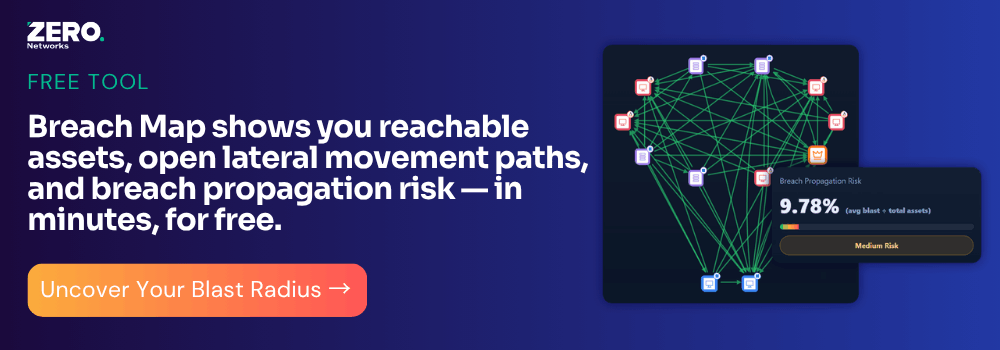
While CVSS measures theoretical severity, it doesn’t clarify your business’ actual exposure. To assess the potential real-world impact of a vulnerability exploit, enterprises should map their internal network to discover reachable assets, how they connect, where attackers could move, and what they could reach. Free tools like Zero Networks’ Breach Map are the fastest way to uncover your blast radius and learn where an exploit could cause the most damage.
2. Close Unnecessary Access Paths by Default with Microsegmentation
Vulnerabilities give attackers an initial foothold but excessive lateral movement exposure is what turns minor cyber incidents into widespread breaches. Zero Networks' 2026 Lateral Movement Exposure Report found 80% of enterprise servers are reachable from anywhere on the network, and 85% of internal systems are directly accessible from a single compromised host. In other words, attackers typically inherit broad internal access regardless of how they initially breach the network – whether that’s via a vulnerability exploit or any other vector.
Microsegmentation eliminates the internal pathways that exist for convenience rather than verified business need. Even if an attacker manages to gain initial access to a granularly segmented network, they’ll hit an immediate dead end because lateral movement is prevented by design.
3. Buy Time to Patch Safely with Network- and Identity-Based Controls
If a patch introduces outage risks of its own, it’s not a true fix. While patch availability is skyrocketing, security teams can’t realistically validate every patch quickly enough to remediate all newly discovered vulnerabilities. Even if bandwidth weren’t a barrier, OT and legacy systems can't always be patched on short notice without planning significant change windows that risk production impact.
Organizations that have already implemented identity-based microsegmentation have built a foundational buffer against vulnerabilities; when a specific flaw poses a particularly urgent business risk, security teams have the tools in place to build a targeted rule that addresses the exposure until a patch can be deployed safely.
For example, B. Riley Financial faced a Microsoft Outlook vulnerability involving outbound SMB traffic that left the firm exposed with no patch available from the vendor. Waiting for a fix meant leaving the exposure open, so they worked with Zero Networks to deploy a targeted rule blocking outbound SMB traffic from Outlook to the internet, closing the specific path the vulnerability relied on.
“Having microsegmentation in place has really given us a precautionary protection layer so we can delay applying some of these patches. This gives us plenty of time to test, make sure everything’s working, and then apply it, but still have that protection layer in place.”
- Aaron Goodwin, CISO, B. Riley Financial
4. Automate Threat Containment Independent of Detection
Last year, 29% of vulnerabilities in CISA’s KEV catalog were attacked before public disclosure, meaning exploitation was underway before defenders knew what to look for. Containment that depends on catching an exploit in progress inherits the same speed disadvantage as patching: a human SOC – or even an automated detection tool – still has to notice, verify, and respond before damage spreads. The probability that every step in the detect-and-respond chain works flawlessly and fast enough to stop machine-speed threats? Near zero.
Built-in containment removes the dependency on detection and response workflows. If access paths are closed by default and enforcement doesn't require a trigger, a compromised asset can't move laterally regardless of whether the malicious activity is immediately detected. That's the difference between a reactive strategy and architecture that makes the attack's next move impossible from the start – and it becomes more consequential every month frontier AI compresses the window for containment.
Build Proactive Vulnerability Protection in the AI Era with Zero Networks
Zero Networks’ automated, identity-based microsegmentation agentlessly orchestrates native firewalls to isolate every asset, preventing lateral movement and building a containment layer against vulnerability exploits – no matter how quickly they’re executed.
Unlike reactive tools that depend on known indicators, Zero builds a proactive security posture that prevents attacks from spreading at the architectural level, effectively mitigating the impact of vulnerabilities so security teams can protect business continuity while buying time to patch safely.
Get a firsthand look at how you can build a closed-by-default architecture and stay resilient against machine-speed threats – request a demo.