Attack Path Analysis for Business Resilience: Mapping Cyber Risk Exposure
Published August 01, 2026

Mikella Marley Content Marketing Manager

In most enterprises, a single compromised endpoint directly exposes 85% of the environment. In fact, Zero Networks' 2026 Lateral Movement Exposure Report found that 12.2% of enterprise environments expose at least one user-to-server administrative pathway – a direct route from compromised endpoint to crown jewels.
While most businesses know what their critical assets are, far fewer have a clear understanding of their true cyber risk exposure – or what to do about it. This is especially true for cyber pros watching AI proliferate in the wild and within their networks; most organizations are still working to understand external and internal AI threat exposure, let alone forge a path to AI control. We’ll lay out a framework for analyzing attack paths as part of a business impact analysis, enabling security leaders to build a cyber resilience strategy that directly maps to business outcomes.
Key Answers
- How does attack path analysis work? An attack path analysis traces the route an attacker could take from an initial point of compromise to a critical asset and measures the controls that stand in the way to uncover the true scope of exposure. This can be completed as a phased process (involving discovery, modeling, and pathfinding), or automated using free resources like Zero Networks’ Breach Map tool.
- What is the role of an attack path analysis in a business impact analysis (BIA)? A BIA identifies which assets are critical and what downtime would cost; attack path analysis clarifies how exposed those critical assets are and identifies priority interventions for security leaders targeting cyber resilience objectives.
- How should enterprises prioritize business resilience investments? By identifying the attack paths with the highest business impact relative to containment readiness, then implementing controls that increase path distance or eliminate entire attack scenarios (like microsegmentation), minimize privilege exposure (just-in-time authentication), and constrain potential damage to key resources (identity-based access controls).
What is Attack Path Analysis?
An attack path analysis identifies the route an attacker could take from an initial point of compromise to a critical asset, translating unstructured risk exposure insights into a view of real, exploitable paths.
In the context of a business impact analysis (BIA), attack path analysis shouldn’t only identify exploitable attack paths to critical assets specifically but should also uncover the interventions that will most meaningfully improve cyber and operational resilience.
How to Use Attack Path Analysis in a BIA
A business impact analysis starts with identifying which systems and assets are critical to the strategic success and day-to-day operations of the company. Documenting critical assets – and establishing a baseline estimate of what downtime would cost – is the first step in tailoring cyber resilience strategies to business priorities. An attack path analysis answers the logical follow-up question: how exposed are critical assets?
To uncover the scope of business exposure, attack path analysis maps open pathways and evaluates the level of effort it would take an attacker to move from a common ingress point to a critical asset, giving organizations a documented map of true exposure tied to likely attack tactics rather than a general sense of risk.
A list of critical assets tells you what’s important, not where to act first. A cyber resilience focused attack path analysis turns that list into a prioritized map of where risk exposure and business impact intersect most sharply.
Attack Path vs. Attack Vector vs. Attack Surface
Security teams will deal with three related yet distinct terms when mapping and evaluating attack paths as part of a BIA:
- Attack surface is the sum of all points in your environment where an attacker could potentially gain entry or exploit a vulnerability – every exposed port, every identity, every endpoint, every cloud workload, and every third-party integration. The larger and more complex your environment, the broader your attack surface.
- An attack vector is the specific method an attacker uses to exploit a point in the attack surface and gain an initial foothold. For example, compromised credentials or vulnerability exploitation are common attack vectors.
- An attack path is the route an attacker travels along through the environment after gaining initial access to reach critical assets – the amount of damage they could do along the way makes up an organization’s blast radius.
In other words, attack surface describes what can be breached, an attack vector is how breaches can occur, and attack paths illustrate where adversaries can go after gaining initial access to eventually reach critical systems.
4 Attack Vectors to Map for Every Critical Asset
Starting with the most business-critical assets, security teams should analyze attack paths using scenarios that reflect today's threat landscape:
- Compromised user: A standard user account compromised through phishing, credential theft, or malware.
- Compromised cloud identity or AI agent: Stolen credentials or session tokens for a SaaS, IaaS, or agentic identity, often exploited to pivot into on-premises resources through federation, single sign-on trust relationships, or an AI agent’s standing access.
- Technical perimeter entry: Exploitation of an internet-facing device or service, such as a VPN concentrator, edge firewall, or public-facing web application, to gain code execution and a foothold for further lateral movement.
- Trusted vendor/third-party access: A compromised or malicious third party using pre-existing privileged access, like a vendor VPN connection or API integration, to reach internal systems.
For each critical asset, trace the shortest plausible path per vector.
How to Map Attack Paths: Discovery, Modeling, and Pathfinding
With critical assets and relevant attack vectors identified, security teams can begin mapping the attack paths they’ll use to analyze exposure – when done manually, this typically happens in three stages:
1. Discovery: Inventory Systems, Identities, and Connections
Uncovering attack paths starts with an accurate view of all network assets, identities, connections – including service accounts, AI agents, and other traditionally under-monitored parts of the network – to effectively track how they might contribute to an exploitable pathway between a given entry point and a critical asset.
2. Modeling: Uncover Communication Pathways
Convert discovered inventory into a graphical view of what’s reachable across on-prem, cloud, IoT/OT, and Kubernetes: which systems and identities can access which assets, through what trust relationships, and whether or not that access shows up in routine traffic.

3. Pathfinding: Chain Exploitable Steps Together
Starting from a pre-defined entry point, trace the routes an attacker could exploit, including paths gated behind authentication or JIT approval, that lead to a critical asset. At enterprise scale, this usually requires graph traversal algorithms to enumerate every path reachable from an entry point to a given asset.
Automated Attack Path Mapping
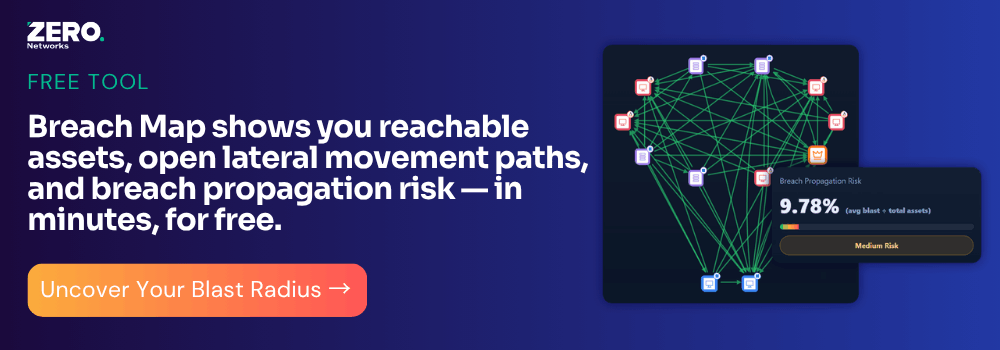
For enterprises that need an accurate view of exposure without months of manual background work, free tools like Zero Networks’ Breach Map automate all three stages. Breach Map scans the internal network to discover reachable assets, then generates an interactive visual map showing how assets connect, where attackers would move, and what they could reach.
The report surfaces total assets discovered, how many are reachable via lateral movement, average blast radius, attack surface, and direct and indirect crown jewel risk – without weeks of manual discovery and log analysis. It also acts as a personalized benchmark tool for cyber leaders and teams as they work to lock down key attack paths.
Analyzing Attack Paths: How to Measure Cyber Risk Exposure
After mapping attack paths from entry point to critical asset, security teams can analyze paths against three threat containment metrics that signal the true scope of exposure.
|
Metric |
What It Measures |
What to Document |
|
Path Distance |
Barriers between entry point and asset |
Authentication boundaries, segments traversed, inspection points, cross-domain crossings |
|
Privilege Requirements |
Difficulty of gaining usable access to a resource |
Escalation levels, persistent privileged access, service account density, added authentication |
|
Data-Layer Controls |
How much damage an attacker could do upon reaching a critical asset |
Encryption at rest, identity-based access controls |
Path Distance: How Attackers Move Laterally Through the Network
Path distance is the most consequential dimension to measure, because interventions here can remove risk rather than just raising its cost. For example, microsegmentation can close lateral movement pathways and effectively eliminate entire compromise scenarios. For the purposes of measuring containment, focus on assessing four things:
- Authentication boundaries crossed: Distinct credential challenges between entry point and asset, excluding any boundary satisfied by credentials the attacker already holds.
- Network segments traversed: Segments governed by actively enforced, granular policy – not segmentation that exists on paper but permits broad access in practice due to accumulated exceptions and policy drift.
- Enforced inspection points in path: Tools actively operating in prevention mode; detection-only controls don't count, since they depend on a human responding in time.
- Cross-domain traversal: Genuine trust boundary crossings, like on-prem to cloud or IT to OT, that demand a distinct credential set rather than one satisfied by shared federation.
Privilege Requirements: What Permissions Attackers Need to Access Critical Assets
Reaching an asset isn't the same as accessing it. Privilege requirements measure how difficult it is for an attacker to obtain the privileges needed to actually impact a critical asset. As a measure of containment, this dimension carries less weight than path distance because privilege controls typically raise the cost of an attack (rather than removing the route entirely via structural controls), but the two are deeply interconnected. Privilege requirements should be captured through details like:
- Escalation levels required: Each distinct privilege escalation is a separate point of potential failure for attackers, though shortcuts like cached credentials or over-provisioned service accounts can collapse multiple levels into one.
- Persistent privileged access: Standing access without just-in-time reauthentication means a single compromised credential can be a ticket to critical assets on its own.
- Service account density: Broadly scoped service accounts are frequent escalation targets and are often excluded from user activity monitoring.
Additional authentication requirements: Hardware tokens or out-of-band approval that the entry vector can't reasonably satisfy caps the blast radius outright.
Data-Layer Controls: Limiting Damage After a Breach
The final containment dimension to assess along identified attack paths answers the only remaining question: if an attacker reaches the critical asset and manages to gain access, how much damage can they do? This can be measured through controls such as:
- Encryption at rest: With separated key management, a successful compromise can corrupt or delete data but not read or exfiltrate it.
- Identity-based access controls: Granular access controls limit what any single compromised identity can reach even after accessing a resource, enforcing a final layer of protection for the most sensitive data.
How to Identify Top Business Resilience Priorities and Investments
After analyzing attack paths to critical assets for current containment controls, security leaders should have three things:
- An inventory of business-critical assets and an understanding of downtime thresholds
- A view of all pathways from common ingress points to those critical resources
- A breakdown of how exposed the exploitable paths truly are, measured against containment controls
With these insights, the final analysis can be completed – the goal is to find where business impact and containment readiness converge most sharply. For example, if a billing system has an extremely low downtime threshold due to its high revenue impact but is directly accessible within two lateral movement pivots via compromised user credentials, then it should rank as a high priority.
With priorities defined, security leaders have a blueprint for tying cyber resilience directly to business impact. Resilience strategies should be implemented using same threat containment dimensions that help uncover risk exposure and define urgency:
- Increase path distance or completely remove pathways to critical assets: Granular network segmentation, additional authentication boundaries, and inspection points can eliminate entire compromise scenarios.
- Reduce privilege exposure: Eliminating persistent privileged access, reducing service account scope, and enforcing just-in-time reauthentication or additional authentication requirements for critical assets can rein in the privilege sprawl attackers rely on.
- Enforce data layer controls: Implementing granular identity-based access controls and encryption at rest limits the damage an attacker can do if they manage to reach critical systems.
As security leaders take a more active role in business continuity, this framework delivers a repeatable way to align cyber resilience strategies with board-level priorities.
Cyber Resilient by Design: Protect Uptime with Zero Networks' Automated, Identity-Driven Microsegmentation
Zero Networks proactively blocks threats to protect operational continuity with automated, identity-based microsegmentation, delivering the containment layer environments need to close attack paths without impacting legitimate traffic.
Zero provides immediate visibility into every identity and asset on the network, then automatically enforces adaptive, identity-aligned policies based on observed network behavior. With always-current network visibility and a deterministic, human-on-the-loop automation engine, Zero Networks delivers preemptive cyber resilience with no manual effort or operational complexity.
Learn how you can build a closed-by-default architecture that measurably improves business resilience – request a demo.