Cyber Insurance Compliance: 5 Ways to Cut Premiums
Published January 12, 2026

Mikella Marley Content Marketing Manager

The global cybersecurity insurance market has grown to roughly $20 billion in 2026 – a trend that’s expected to continue as sophisticated ransomware campaigns, AI-enabled attacks, and regulatory pressures rise. Still, with cybercrime projected to cause trillions of dollars in economic damage in 2026, a growing protection gap leaves many organizations vulnerable to new and evolving threats.
Although organizations rank cybersecurity threats as their top concern, roughly one-fifth of medium and large enterprises have yet to purchase cyber insurance coverage. Why? The price of coverage is the #1 reported barrier, as market research suggests businesses are facing 30% premium rate hikes.
In other words, as cyber insurance becomes central to a risk preparedness strategy, security leaders must find a way to minimize premiums in an era of heightened underwriter scrutiny.
What Are the Key Requirements for Cyber Insurance Coverage?
To qualify for cybersecurity insurance coverage, organizations are typically expected to demonstrate a set of technical security controls and operational best practices.
While specific requirements vary depending on carrier, policy, and individual organizations’ security posture, they typically include strategies like multi-factor authentication, network segmentation, identity-based access controls, and incident response plans.

While core requirements like these remain relevant, underwriters are increasing their focus on cyber hygiene and proactive protection in response to the evolving threat landscape. For example, insurers are expected to require stronger AI-risk management programs in 2026, as well as tighter identity-based controls to minimize privilege escalation amid a wave of business email compromise claims.
Cutting Cybersecurity Insurance Costs: Best Practices to Lower Premiums
Qualifying for cybersecurity insurance coverage in the first place can prove challenging – minimizing premiums is an even taller order. Security leaders tasked with enhancing protection while cutting costs can build a multi-dimensional defense that boosts underwriter confidence by prioritizing five key best practices.
Prevent Lateral Movement with Microsegmentation
Lateral movement is a key ingredient in cyber attackers’ recipe for success. As Aaron Goodwin, CISO at B. Riley Financial, points out, stopping lateral movement enables organizations to contain threats and drive down cyber insurance costs in one fell swoop:
Microsegmentation is the gold standard in lateral movement prevention, instantly isolating and neutralizing threats. Because of this, nearly 70% of organizations say their cyber insurance provider requires network segmentation – but not all network segmentation strategies are created equal.
For example, many organizations use VLANs as a foundational network segmentation strategy, but this approach is far less comprehensive than automated microsegmentation. That’s why 75% of insurers now assess segmentation posture during underwriting; organizations with higher segmentation maturity say they’ve received lower insurance premiums.
Enforce Least Privilege Access Everywhere with Granular Identity-Based Controls
Credential abuse remains the #1 initial access vector for data breaches globally. This era of rising identity-based attacks is transforming how cyber insurers think about risk. As Jeff Bird, Cybersecurity Advisory Lead for insurance brokerage and risk management firm, Marsh, put it: “Much of what we see today isn’t about breaking in. It’s about logging in using stolen credentials, for instance, to operate as a legitimate user.”
Meanwhile, many organizations have embraced detection-centric security strategies, leaning into solutions like EDR and SIEM, making identity-based tactics a viable path for adversaries to fly under the radar. For example, attackers are targeting machine identities like service accounts – which now make up over 70% of networked identities – to pivot across the network undetected.
Cyber insurance providers need proof that one stolen credential won’t spell disaster. Applying granular controls based on the identity of users, devices, or applications to scale least privilege access policies across the entire network allows security teams to demonstrate superior protection against identity threats.
Secure Privileged Access with Just-in-Time MFA
Even if a network had no misconfigurations or excessive privileges, certain accounts, ports, and assets would remain a ticket to privilege escalation for hackers. By applying just-in-time MFA to all admin accounts and privileged protocols like RDP, SSH, and WinRM, organizations add a critical layer of protection to cut off key pathways without disrupting operations.
The combination of network segmentation and identity segmentation, fortified by just-in-time MFA, creates a multi-dimensional defense that tells cyber insurers an organization is prepared to contain breaches in real time.
Prioritize Business Resilience to Transform Incident Response
Incident response (IR) planning reduces the average cost of a data breach by nearly $250,000, so it’s no surprise that insurance providers commonly ask for IR plans as a condition of coverage. But in the context of today’s dynamic digital landscapes, incident response playbooks quickly become outdated.
Ultimately, cyber insurers want proof that an organization is prepared to withstand inevitable cyber incidents with minimal impact. Rather than focusing solely on rigid and inherently reactive IR plans, organizations should prioritize proactive controls to enhance business resilience.
Beyond demonstrating detection and response capabilities alone, security teams can prove automated threat containment will better satisfy underwriters’ resilience requirements.
Future-Proof Regulatory Compliance
First-party cyber insurance coverage often covers fees, fines, or penalties resulting from a breach, so heightened regulatory pressure means carriers are increasingly looking for ways to avoid non-compliance payouts.
Amid a patchwork of regulatory requirements and industry best practices, organizations must implement the core cybersecurity standards that apply across frameworks to satisfy auditors and underwriters alike.
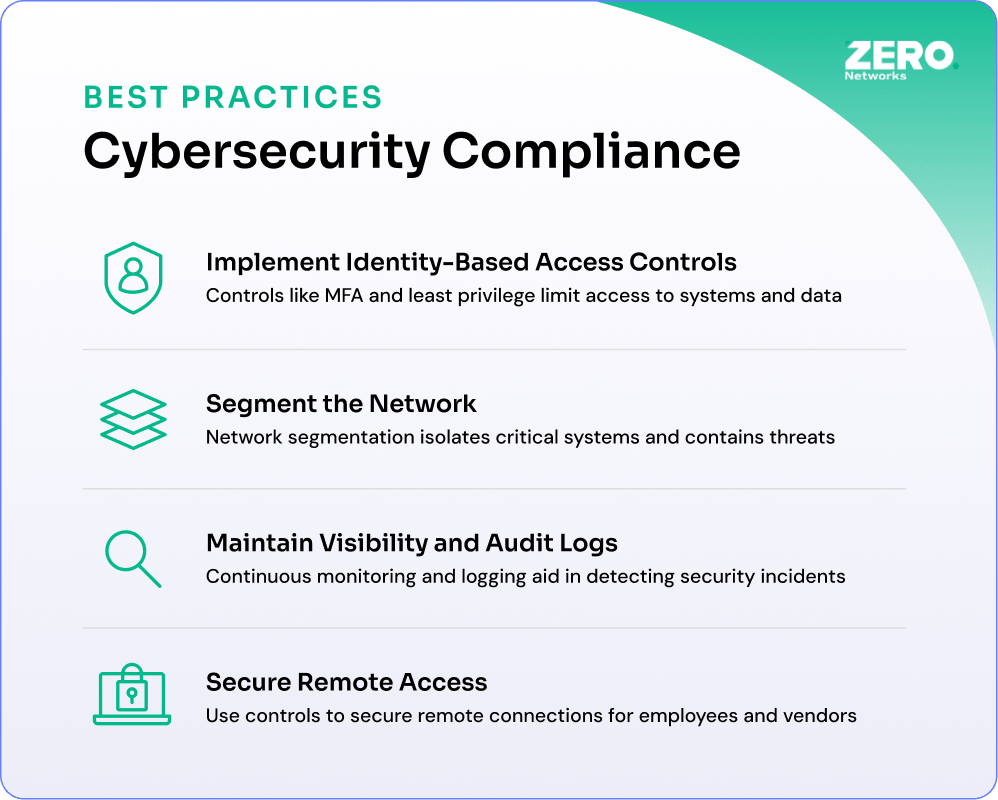
These key controls and procedures should continuously adapt alongside network changes, signaling that an organization’s compliance strategy is flexible while also ensuring cyber threats cannot slip through hidden security gaps.
Strengthen Security, Slash Cyber Insurance Premiums: How Zero Networks Helps
Cyber insurers need to know that an organization’s security posture is built for business continuity with a foundation in Zero Trust Architecture. Zero Networks’ platform combines advanced Network Segmentation, Identity Segmentation, and Zero Trust Network Access solutions, fortified by network-layer MFA, to deliver multi-dimensional protection that dynamically adapts to changing networks and evolving risks.
The result? A self-defending network architecture that boosts underwriters’ confidence and security teams’ peace of mind while driving premiums down.

See for yourself how Zero Networks’ automated, identity-aligned microsegmentation delivers dynamic protection across complex environments – request a demo.