CISO’s Guide to Business Impact Analysis: 3 Steps to Strengthen Cyber Resilience
Published July 08, 2026

Mikella Marley Content Marketing Manager

After gaining initial access, attackers begin moving laterally in as little as 27 seconds – and a single compromised host directly exposes 85% of the environment. Still, it takes an average of 200+ days to identify and contain a breach.
As models like Mythos, Daybreak, and other tools attackers weaponize for AI-driven exploits compress the window between initial compromise and business disruption even further, time is no longer on the defender’s side. Security teams can no longer afford to plan for prevention; they must engineer for the impact of a breach.
A business impact analysis (BIA) is a vital step in gaining consequence clarity and tailoring cyber resilience strategies to business and board-level priorities. But all too often, a BIA documents critical systems, the disruptions that would materially impact the organization, and how long the business can tolerate downtime without detailing current exposure or producing cyber resilience priorities.
We’ll walk through a business impact analysis template that translates documented business priorities into actionable cyber resilience enforcement steps, giving CISOs the necessary insights to protect uptime where it matters most.
How to Conduct a Business Impact Analysis for Cyber Resilience: 3-Step Framework
A BIA built to produce resilient architecture, not just documentation, moves through three steps: critical asset identification and business exposure quantification, attack path analysis and containment metrics, and investment prioritization. Each step is designed to hand off concrete inputs to the next, ultimately delivering a set of specific intervention priorities tied to specific exposure reductions.
Step 1: Identify Critical Assets and Quantify Business Exposure
The first step in resilience-focused business impact analysis is to identify which systems and assets are critical to the strategic success and day-to-day operations of the company. This means evaluating assets across five dimensions of business exposure:
- Regulatory Classification: If an asset contains data that is restricted by regulations, then a compromise could incur fines, time-consuming reporting, and disclosure requirements.
- Revenue Exposure: If an asset is critical to delivering goods and services or measuring consumption of goods and services, any downtime or breach would disrupt revenue streams and could even force the organization to pay penalties or credits to impacted customers.
- Financial Sensitivity: If an asset has the ability to issue or redirect payments, compromise could impact the organization’s operational cash flow.
- Customer Notification Requirements: If customer notification processes – often tied to revenue exposure and regulatory classification – are required due to a cyber incident, they can impact ongoing customer conversations and sales cycles.
- Reputational Sensitivity: If assets containing data or conducting functions that are core to the organization’s communications or value proposal are impacted by a breach, it could cause reputational harm.
Identifying business-critical systems requires collaboration across multiple stakeholders – CISOs need to gather information from CROs, CIOs, COOs, and business unit leaders to fully grasp the organization’s overall risk exposure and the disruptions that would materially impact uptime, revenue, or customer commitments, ensuring the assessment reflects real-world operational priorities.
Following this step, CISOs should have a preliminary list of critical assets, enough information to justify why it’s critical, and a baseline estimation of the business impact if a compromise occurred.
Step 2: Analyze Attack Paths Against Containment Metrics
With an inventory of critical assets and an understanding of how downtime would impact the business, CISOs can tackle the question that most urgently affects business continuity: how exposed are critical systems today?
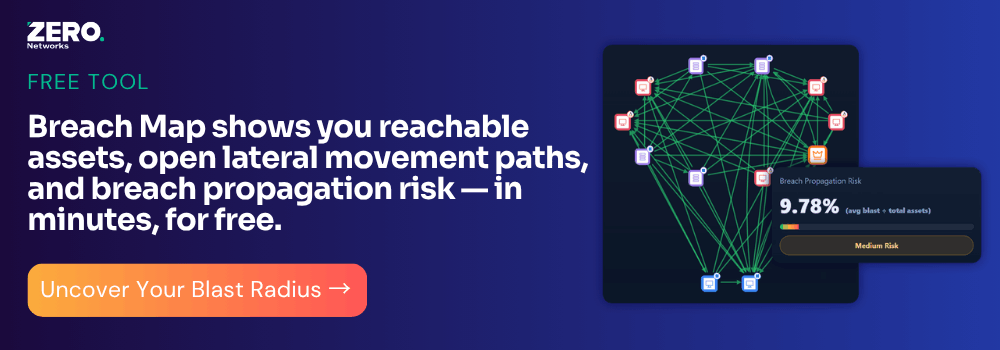
This is where many BIAs miss out on delivering practical value – they document priorities on paper without establishing whether critical systems are actually protected or where they’re vulnerable.
An attack path analysis evaluates the level of effort it would take an attacker to move from a common ingress point to a business-critical asset. No analysis can comprehensively map every breach scenario, so CISOs should focus on categories that reflect the current threat landscape, like:
- Compromised user
- Compromised cloud identity
- Technical perimeter entry
- Trusted vendor/third-party access
For each threat category and critical system, security teams should identify the nearest ingress point and map a plausible attack path relative to three containment dimensions: path distance, privilege requirements, and data-layer controls.
|
Containment Dimension |
What It Measures |
Specific Details to Capture |
|---|---|---|
|
Lateral Movement Path Distance: How do I get there? |
How many structural barriers and controls exist between the ingress point for a breach scenario and the critical asset. |
|
|
Privilege Requirements: Can I access the resource once I’m there? |
How difficult it is for an attacker to gain the privileges needed to reach the critical asset. |
|
|
Data Layer Controls: How much damage can I do? |
How much damage an attacker could do once they reach the critical asset. |
|
The result, run across every combination of scenario and critical asset, is a documented map of exposure tied to likely attack tactics rather than a general sense of risk. This breakdown of exposure across all critical assets bubbles up to two enterprise-level risk insights:
- Asset-level worst case path: The compromise scenario that presents the shortest, least obstructed route for an attacker to reach a business-critical system.
- Enterprise-level highest cost path: The single scenario-to-asset combination with the weakest containment and the highest business exposure – the easiest attack with the greatest business impact.
These insights deliver a baseline for measuring cyber resilience improvements over time, and a natural starting point for prioritizing enforcement and investment.
Step 3: Prioritize Security Strategies and Investments for Reducing Business Risk Exposure
With critical assets identified and their exposure mapped against likely attack scenarios, CISOs have what they need to answer the question that turns documentation into a cyber resilience roadmap: what actions will reduce the most risk – and fastest?
As a general principle, interventions that reduce blast radius structurally, by eliminating an attacker's ability to reach a critical asset in the first place, are more durable than interventions that depend on detecting and responding to an attack already in progress. With that in mind, security teams should focus on strengthening the same dimensions of threat containment used to analyze exposure:
- Increase path distance or completely remove pathways to critical assets: Granular network segmentation, additional authentication boundaries, and inspection points placed along the worst-case attack path can eliminate entire compromise scenarios rather than simply slowing them down.
- Reduce privilege exposure: Eliminating persistent privileged access, reducing service account scope, enforcing just-in-time reauthentication, and introducing additional authentication requirements for critical assets can reduce privilege exposure, making it harder for attackers to successfully reach critical assets.
- Enforce data layer controls: Implementing identity-based access controls and encryption at rest limits the potential damage if attackers do manage to reach critical systems, helping to ensure that a compromise won’t escalate to downtime.
For each recommended intervention, CISOs should document the expected impact in terms the business understands: which worst-case path do these strategies break or lengthen, which critical assets do they better protect, and how do they reduce business exposure? This creates a direct line from investment to risk reduction, making budgetary conversations concrete and clearly tying security outcomes to business continuity.
Build a Cyber Resilient Architecture with Zero Networks
Zero Networks closes the gap between business priorities and real-world enforcement with automated, identity-based microsegmentation. Zero provides immediate visibility into every identity and asset on the network, then automatically enforces adaptive, identity-aligned policies that prevent lateral movement to critical assets to safeguard business resilience.
The average Zero customer achieves 90%+ segmentation within 90 days, achieving comprehensive protection that measurably reduces risk exposure without disrupting regular operations.
Find out how Zero Networks can help you build a cyber resilient architecture with measurable business value – request a demo.