Video
Self-Defending by Design: The Future of Cybersecurity Defense
The question for defenders today isn't if a breach will happen – it's when? And what happens next? This Global Sustainable Trade Initiative feature explores why lateral movement prevention and instant breach containment are defining challenges of modern cybersecurity, and how Zero Networks' automated, identity-aligned microsegmentation delivers comprehensive protection without the heavy manual burden. Watch the video to learn:
- Why building self-defending networks is critical in the modern threat landscape
- How Zero Networks combines network and identity controls into a dynamic defense fabric
- The role of deterministic automation in building an adaptive security posture
- Strategies for achieving the granular access control required for compliance and peace of mind
Summary
Microsegmentation stops ransomware by putting a boundary around every asset, so an attacker who gets in can’t move laterally to the next machine. In this video, Zero Networks VP of Marketing Daisy Spiridopoulos, Field CTO Albert Estevez, and VP of Customers Nicholas DiCola explain why breaches are now inevitable, why microsegmentation used to take years, and how Zero Networks’ automation engine delivers it in months.
Key takeaways
- Assume breach, then stop the successful breach. Customers were getting breached no matter what they did. So Zero Networks focuses on what happens after the breach: stopping the attacker from spreading.
- Lateral movement is how ransomware wins. Attackers use ports already open in the network, like RDP and SSH, to reach other machines. Stop lateral movement and you stop ransomware.
- Microsegmentation puts a bubble around every asset. It controls what traffic gets in and what traffic gets out, protecting each asset from the inside as well as the outside.
- Automation is what changed. Zero Networks learns every asset and network flow, then generates policies from expert knowledge. For example, it recognizes a SQL Server and already knows how to protect it, so environments are segmented in months instead of years without breaking anything.
- It simplifies compliance. Granular segmentation plus just-in-time MFA lets regulated organizations require MFA for all privileged access across the environment.
Speakers: Daisy Spiridopoulos, VP of Marketing, Zero Networks · Albert Estevez, Field CTO, Zero Networks · Nicholas DiCola, VP of Customers & Cybersecurity Jedi, Zero Networks
Why are breaches inevitable?
Daisy Spiridopoulos: The modern cybersecurity landscape is only getting more complex. The network perimeter is only becoming blurred. It’s becoming much, much harder to define what the perimeter is for any given enterprise network. What you have to keep in mind is that at this point a breach is inevitable.
Albert Estevez: If we talk about lateral movement, so the bad actors, the ransomware, you know, the the malware, what they try to utilize is something that is open already in your network. Ports like RDP, SSH, you know, ports that they can give you privilege access to another machine. Instead of spending a lot of energy after a breach happens, why we don’t apply something that really prevents the lateral movement and really makes impossible for ransomware to proceed and spread in networks?
Nicholas DiCola: I hear from customers that, hey, we have a very complex environment. It’s a mix of on-prem and hybrid and cloud, and ultimately this makes securing that almost impossible. Automation today can actually make that very easy for the customer. And so it’s a change in mindset of, hey, we don’t have to do everything manually. We can actually use automation to make this simple in these days.
Why did Zero Networks build an automation engine?
Daisy Spiridopoulos: Zero Networks’ original vision came from the founders’ experience of working in cybersecurity and noticing that no matter what they did, the customers were still being breached. And so if the customers are still going to be breached, the best place to put defense is after that breach occurs. How can we stop that breach from succeeding? So the point is not to stop a breach. The point is to stop a successful breach.
Albert Estevez: So Zero Networks is putting the power in the hands of the defenders. So thanks to the automation engine that we have, and we are generating security policies based on the flows that we identified, and this is doesn’t happen overnight. So we spent a lot of years trying to build an engine with a lot of knowledge from experts, not just, you know, classifying AI LLM that everybody has today. So we generated a really deterministic engine based on knowledge. If you detect a SQL Server, we know already how to protect the SQL Server. We don’t need to guess. So we can reduce the time to generate security policies without breaking anything. So this is game-changing.
What is a self-defending network?
Nicholas DiCola: When I talk to customers and I hear about their concerns with the networks, they’re starting to think, okay, how do I defend the network from the inside if the attacker is already in the network? How do I secure that and help make the network self-defending? So now, if an attacker gets in, they can’t laterally move. They can’t spread to the next thing. And ultimately, you know, customers have a lot of detections and those aren’t working today. So they need protective measures to also go with those detections so they can stop the attacker from spreading.
What is microsegmentation?
Daisy Spiridopoulos: And so a network that is designed to be self-defending is actually leveraging something called microsegmentation. But what is microsegmentation?
Albert Estevez: So microsegmentation is the the technique that we utilize to, like, to create, like, a bubble around an an asset to really protect the asset not just from the outside but from the inside as well. So we control what traffic is going to be allowed to get in, and we are going to control what the traffic that going to be out. For decades we we focused and apply security in the network. But at the end of the day, what you need to protect is the the the endpoint, the target. Ensuring that you have the protections in the endpoint makes really hard for attackers or ransomware to really succeed.
Why is microsegmentation urgent?
Daisy Spiridopoulos: Implementing microsegmentation is as urgent today as it ever has been. 60 to 70% of all breaches leverage lateral movement to succeed. Ransomware is not going anywhere anytime soon, and lateral movement is the number one mechanism by which it succeeds. If you stop lateral movement, you stop ransomware. The best way to stop lateral movement is microsegmentation.
How does microsegmentation help with compliance?
Nicholas DiCola: So when I talk to customers that are in highly regulated environments or verticals, we’re seeing more and more that there’s granular access controls around these systems, especially around privileged access, to achieve granular access for compliance purposes in highly regulated verticals. You’re essentially taking the network down to the smallest bits and only allowing the things that are needed. And that’s the most granular access you can have to achieve that compliance requirement. And there even some now are requiring MFA for all privileged access in the environment. And with Zero Networks, they’re able to actually achieve that in a very simple way because they now are doing granular access with segmentation. And with our just-in-time MFA, they can apply MFA to all privilege access across the environment.
Why isn’t every company using microsegmentation?
Daisy Spiridopoulos: You might ask yourself, if microsegmentation is so effective, why aren’t more companies using this defense? And the reason is because it sounds difficult on its face. We get that. And historically it has been difficult to deploy in scale. The reason being, if you think about the complexity of governing all the network access and policies, you can see how exponentially difficult that might be. Zero Networks solves this with automation. It’s purpose-built for large, complex network environments. It can learn every asset in your environment and write highly accurate policies in order to allow you to have a microsegmented environment in months instead of years, and something that from day one and then day two continues to dynamically evolve with your network for continuous protection.
Nicholas DiCola: At Zero Networks, we have customers across many verticals — financial, healthcare, manufacturing — and microsegmentation is something that many customers in many verticals need to achieve to reduce vulnerabilities and raise their security posture across the environment. So we’re seeing a trend in these industries that they’re all moving towards this because they know it’s like the next thing that will gain them the most security posture, and they get very excited that, hey, this undertaking that we have to do that we thought was going to be a long process is now very simple, uh, and allows us to actually achieve that security posture that we’re looking for.
What’s Zero Networks’ mission?
Daisy Spiridopoulos: We’re meeting complexity with simplicity, but effective simplicity. What you want are solutions that are simple to deploy but powerful in action. Microsegmentation is that, and Zero Networks finally makes that possible. This is meaningful for everybody. Stopping cyberattacks is important for everybody. You’re going to continue to see us put the defender first in the way we design our solutions. For us, our mandate is to stop lateral movement. And then we want to get that adopted as broadly as possible so that more and more companies have access to the power of this type of tool so that they can start succeeding in the cyber war.
Related Content

- Network Segmentation & Microsegmentation
October 20, 2026
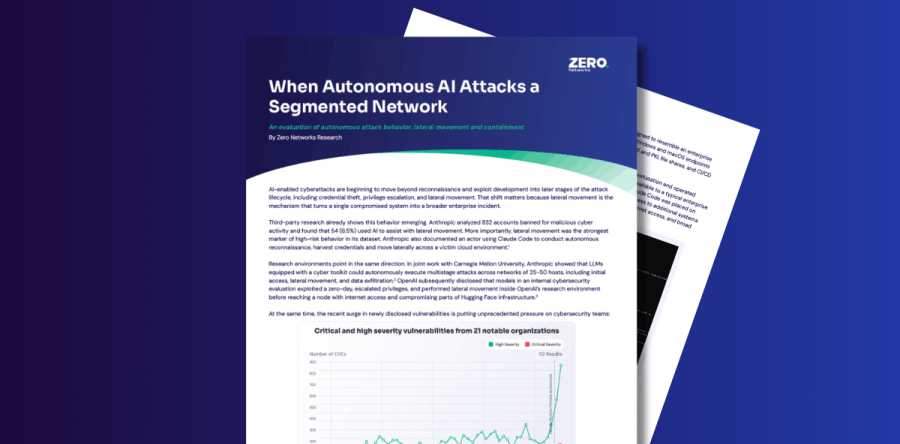
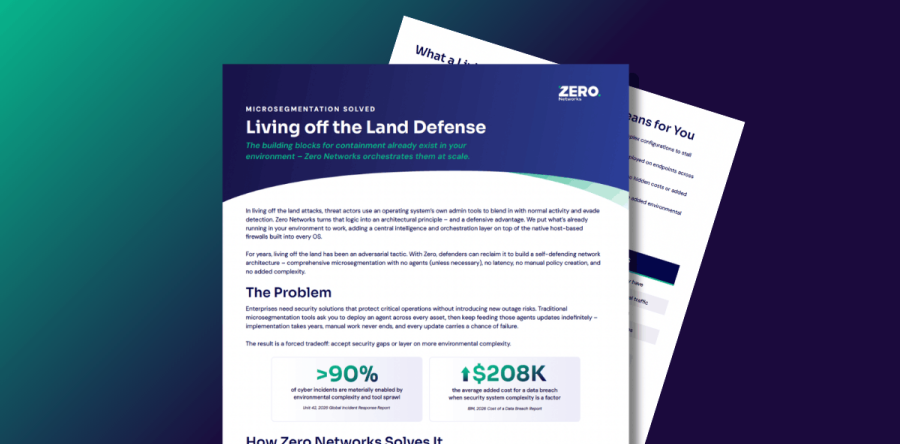
When Autonomous AI Attacks a Segmented Network

- Network Segmentation & Microsegmentation
October 09, 2026
5 Real Reasons Why Microsegmentation Projects Fail—and How Zero Networks Solves Them
- Network Segmentation & Microsegmentation
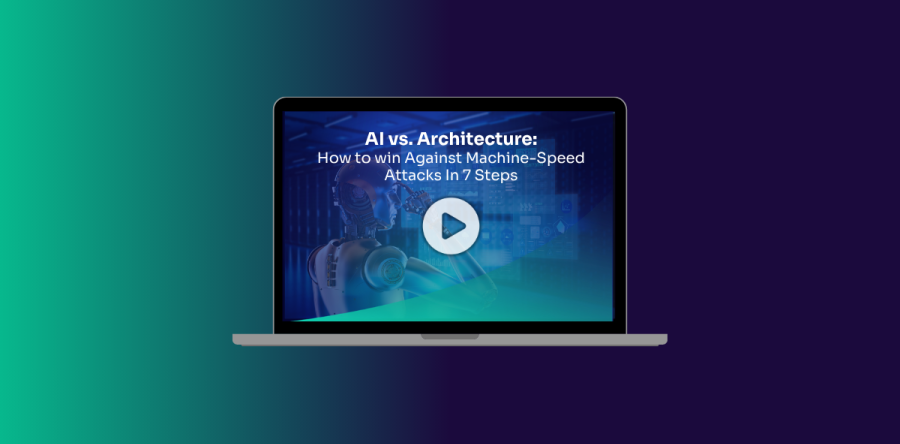
AI vs Architecture: How to Win Against Machine-Speed Attacks

- Network Segmentation & Microsegmentation
September 23, 2026
Autonomous Microsegmentation 101: Why Gartner Says Automation is the Only Way to Contain Breaches on the Global Attack Surface

- Network Segmentation & Microsegmentation
September 23, 2026
What Is a VLAN? Definition, Core Components, and Segmentation Strategies
- Network Segmentation & Microsegmentation
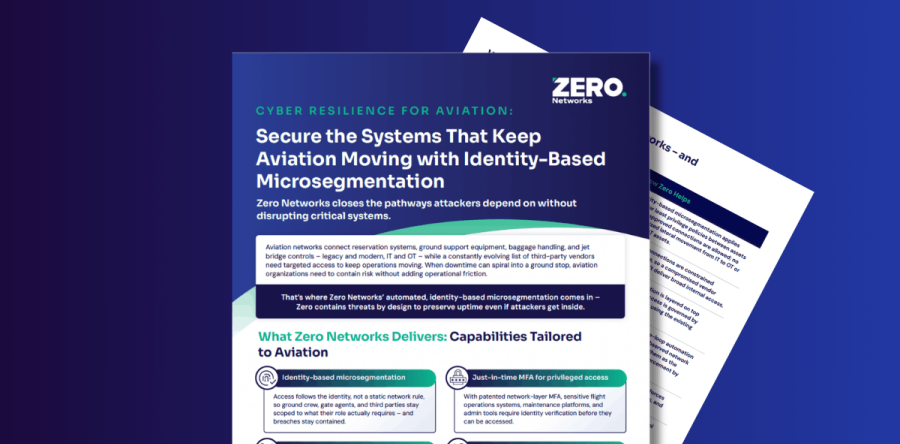
Secure the Systems That Keep Aviation Moving with Identity-Based Microsegmentation
- Network Segmentation & Microsegmentation
Zero Networks Executive Overview: Contain Cyberattacks Before They Disrupt the Business

- Network Segmentation & Microsegmentation
CISO Panel: Three Enterprises. Built-In AI Containment and Cyber Resilience. Here’s How They Did It.
Trusted by


