FUTURE-PROOF NETWORK SECURITY
Preventing Vulnerability Exploitation: A Guide to Cybersecurity Trends and CVEs
Today’s defenders face a constantly expanding list of vulnerabilities while attackers accelerate their use of AI, identity abuse, and supply chain infiltration to turn those weaknesses into rapid, high-impact breaches. Despite surging vulnerabilities, many organizations still rely on patch management strategies designed for the simpler threat landscape of the past. To help security teams effectively defend against increasingly sophisticated exploits, we’ll explore the cybersecurity trends, CVE patterns, and risk dynamics shaping 2026 and beyond – and share best practices for future-proofing network security.
What Are CVEs and Why Do They Matter for Cybersecurity?
The Common Vulnerabilities and Exposures (CVE) program provides a standardized way to identify and share information about publicly known cybersecurity vulnerabilities. Maintained by MITRE and sponsored by the U.S. Cybersecurity and Infrastructure Security Agency (CISA), each CVE record represents a unique weakness that can be exploited by attackers to compromise systems, applications, or networks.
The scale of these vulnerabilities is staggering: more than 40,000 CVEs were published in 2024 alone, a 38% YoY increase. And vulnerabilities aren’t just growing more common, they’re also increasingly impactful – the exploitation of vulnerabilities is now the second-most common initial access vector for security breaches, according to Verizon’s 2025 Data Breach Investigations Report.
With the average organization using thousands of software dependencies and SaaS services, it’s virtually impossible to patch every vulnerability immediately – and that’s exactly why CVEs are valuable for security teams. The CVE program delivers a roadmap for understanding where vulnerabilities exist, which ones are actively being exploited, and how to prioritize them.
CVEs and Zero-Day Vulnerabilities
CVEs and zero-day vulnerabilities are closely related, with one important difference: CVEs represent known risks – zero days are unknown. A zero-day vulnerability refers to a hidden flaw or weakness that can be targeted by a cyber adversary; a CVE number is assigned after a vulnerability is identified.
In many cases, a zero-day vulnerability will eventually be assigned a CVE number after it’s publicly disclosed.
Vulnerability Prioritization: CVSS, KEV, EPSS, and More
Traditional vulnerability scoring systems were built for a slower era of cybersecurity, where defenders had time to evaluate CVEs individually, assess severity, and schedule remediation in predictable cycles. Now, as security teams face tens of thousands of new vulnerabilities each year, defenders need a more modern approach to vulnerability prioritization.
Traditionally, the most widely used vulnerability scoring frameworks include:
- CVSS: The Common Vulnerability Scoring System (CVSS) assigns each vulnerability a score from 0 to 10 based on characteristics like exploitability, impact, and attack complexity. It’s a helpful starting point for understanding how severe a vulnerability could be under the right conditions, but it lacks critical real-world context.
- KEV: CISA’s Known Exploited Vulnerabilities (KEV) Catalog is a curated list of vulnerabilities confirmed to be exploited in the wild and aims to address the gulf between severity and real-world impact left by CVSS. Unlike CVSS, KEV is attacker-driven rather than theoretical, but it’s still wholly reactive.
- EPSS: The Exploit Prediction Scoring System (EPSS) estimates the probability that a given vulnerability will be exploited in the next 30 days using historical exploitation patterns, code-reuse trends, proof-of-concept availability, and more.
To address the inherent limitations of each scoring system, organizations should adopt a tailored prioritization model that weaves together these frameworks as well as environmental context.
The Cybersecurity Trends Defining 2026 and Beyond
Each new wave of vulnerabilities emerges in the context of broader trends shaping the cybersecurity landscape. Understanding these trends helps organizations build a proactive defense as new risks emerge.
Trend 1: Automation and AI Accelerate the Attack Cycle
Attackers increasingly rely on AI and automated scanning tools to discover and exploit CVEs at scale. What once took weeks of reconnaissance now takes minutes – 80% of cyberattacks reviewed in recent research from MIT leveraged AI, signaling that the speed and scale of AI-enhanced attacks are likely to continue accelerating.
Trend 2: Supply Chain and Third-Party Risks Surge
CVE exploitation now frequently begins in the supply chain; in the first half of 2025, supply chain attacks served as the initial access vector for even more publicly disclosed data breaches than ransomware. A compromised library or vendor dependency can give attackers a far-reaching foothold, as observed in high-profile exploits like SolarWinds and MOVEit. To address the rising threats of third-party connections, organizations need to modernize secure remote access strategies and enforce granular access controls to ensure excessive privileges don’t lead to preventable disasters.
Trend 3: Proliferating Shadow IT and Machine Identities
In the AI era, shadow IT has become a particularly pervasive threat – IBM’s 2025 Cost of a Data Breach report found that organizations with high levels of shadow AI use suffered $670k higher breach costs on average. Meanwhile, machine identities like service accounts – which create similar security blind spots – now account for more than 70% of networked identities.
Trend 4: The Cyber Regulatory Lens Tightens
While the average cost of a data breach dropped to $4.44 million globally in 2025, costs in the United States specifically surged to an all-time high of $10.22 million, driven at least in part by “higher regulatory fines and higher detection and escalation costs,” according to IBM. And the strict cybersecurity compliance landscape isn’t confined to the US: from DORA, NIS2, and GDPR to HIPAA, PCI DSS, and beyond, organizations across the globe – and across industries – are facing tighter regulatory requirements with heftier fines for non-compliance.
Trend 5: Malware-Free Attacks and Living-off-the-Land
Malware-free attacks accounted for 79% of detected threats in 2024, according to CrowdStrike’s latest Global Threat Report – up from 40% in 2019. In these “living-off-the-land” or “fileless” attacks, adversaries abuse legitimate tools, systems, files, or applications to compromise the network. In one recent example of this, the BitlockMove vulnerability involved remotely tweaking BitLocker settings via privileged ports to run a planted file under a legitimate user.
Vulnerability Challenges: Top CVEs and the Problem with Patching
Defenders have long relied on a reactive approach to vulnerability management; still, it’s becoming clear that organizations can’t afford to keep chasing CVEs. A closer look at recent years’ most frequently exploited vulnerabilities underscores the urgent need for proactive defense.
According to the 2025 M-Trends Report, some of the most frequently exploited vulnerabilities in recent years include:
- CVE-2024-3400: Disclosed in April 2024, this vulnerability allows command injection through arbitrary file creation.
- CVE-2023-46805 and CVE-2024-21887: Two related vulnerabilities in Ivanti’s Connect Secure VPN and Policy Secure appliances, these CVEs allowed for unauthenticated arbitrary command execution on systems when chained together. MITRE’s 2024 security breach resulted from these vulnerabilities.
- CVE-2023-48788: Using this SQL injection vulnerability in the FortiClient Endpoint Management Server, hackers exploited this vulnerability to execute arbitrary SQL commands within just two weeks of its disclosure.
Other actively exploited or particularly dangerous recent vulnerabilities include:
- CVE-2024-43451: This vulnerability allows attackers to create a malicious URL file that communicates covertly over the SMB protocol with an external server, leaking NTLMv2 password hashes in the process.
- CVE-2025-53779: Known as BadSuccessor, this exploit leverages Directory Managed Service Accounts (dMSA) in Active Directory to gain control over privileged accounts or sensitive systems.
- CVE-2025-33073: Using this vulnerability, attackers fool a target’s SMB client service into thinking it is performing local authentication.
These frequently exploited CVEs harken back to broader cybersecurity trends, like the rise of malware-free and identity-based attacks.
Why Traditional Patch Management Falls Short
After a new vulnerability is discovered, organizations typically wait for an official patch to be released, then rush to apply it everywhere, completing this cycle in an endless loop as new vulnerabilities are disclosed. But this inherently reactive approach leaves critical security gaps.
Even critical vulnerabilities often go unpatched for extended periods of time – nearly a third of CVEs remain exposed for over 180 days. Meanwhile, attackers begin exploiting vulnerabilities within just 5 days of disclosure, and it takes over 240 days to identify and contain these attacks on average.
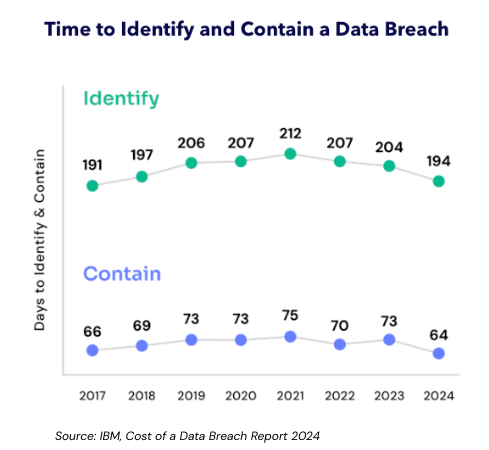
The takeaway? Chasing vulnerabilities with traditional patch management cycles is simply too risky for modern businesses.
Best Practices for Proactive Cybersecurity: Preventing Vulnerability Exploits
Organizations need a proactive approach to prevent vulnerability exploits that mitigates commonly targeted weaknesses and enables instant containment by design. Best practices for building a proactive cybersecurity posture include key strategies like these.
Comprehensive Microsegmentation
Microsegmentation isolates each asset in its own protected zone, preventing lateral movement by default. By enabling organizations to enforce granular policies at the workload level, microsegmentation unlocks more effective application allowlisting and enhanced visibility into network traffic.
Adaptive Identity Access Controls
Even if attackers gain an initial foothold in the network through a known vulnerability, enforcing continuous verification of user, device, and application identities – and ensuring least-privilege access is enforced everywhere – significantly reduces the attack surface. Applying just-in-time MFA to privileged access adds another layer of security, minimizing the risk of escalation.
Zero Trust Architecture
Zero Trust removes implicit trust, automatically treating every connection as risky. This mindset prepares organizations to address both known and unknown vulnerabilities, fostering policies and network architecture that contain by design and grant access dynamically.
Control Outbound Traffic
To protect assets, security teams often focus on guarding against incoming traffic. However, recent vulnerabilities like CVE-2024-43451 remind us that risky exploits can also involve communication to external servers. To mitigate these threats, organizations can create outbound block rules for sensitive protocols like SMB, RDP, and RPC using modern microsegmentation solutions.
How Zero Networks Future-Proofs Network Security
As the shifting cybersecurity landscape leaves defenders to grapple with an ever-increasing list of vulnerabilities, Zero Networks makes it easy to stop exploits of both known vulnerabilities and zero days before they happen.
Unlike reactive tools that depend on known indicators and patches, Zero’s automated, identity-aligned microsegmentation enforces least privilege across the entire network to instantly neutralize attacks. Reinforced with network-layer MFA and Zero Trust Network Access capabilities, Zero Networks delivers comprehensive protection that’s simple to deploy, powerful in action, and resilient even in the face of the unknown.
With this approach, Zero ushers in the Era of the Defender, where the burden of effort no longer falls on defenders reacting to threats, but on attackers – leaving them stranded, penniless, and paralyzed in networks where lateral movement is impossible.
Find out how you can future-proof your network security with Zero – request a demo.