Brochure
The Zero Networks Difference: Buy Protection, Not a Segmentation Project
Download the BrochureLegacy microsegmentation turns into a multi-year project: agents on every machine, manual asset tagging, hand-built policies, and other operational costs that don't show up in the software quote. Zero Networks takes a different approach — automated, agentless-first microsegmentation that delivers 90%+ segmentation coverage within 90 days.
See the two approaches side by side, the seven hidden costs of legacy segmentation, and what enterprise customers say about deploying Zero Networks.
Download the BrochureSummary
Legacy microsegmentation often turns into a multi-year project whose real costs — agent deployment, asset tagging, manual policy work, testing, and maintenance — never appear in the software quote. Zero Networks takes a different approach: automated, agentless-first microsegmentation that delivers 90%+ network protection in weeks, with policies that generate and update automatically. This brochure compares the two approaches across seven criteria, breaks down the seven hidden costs of legacy segmentation, and shares Gartner Peer Insights reviews from enterprise customers.
Key answers
- How is Zero Networks different from legacy microsegmentation? Legacy approaches require agents on every machine, manual asset tagging, and hand-built policies. Zero Networks is agentless-first, with 90% agentless enforcement, automated and optional tagging, and policies that generate automatically from observed behavior.
- How quickly does Zero Networks protect the network? Zero Networks delivers 90%+ network protection in weeks with staged enforcement. Across customer deployments, the median time to a segmented asset is approximately 45 days, including customer change processes.
- What are the hidden costs of legacy microsegmentation? Over three years, legacy approaches carry seven hidden costs beyond licensing: mechanic, policy, tagging, infrastructure, maintenance, delay, and outage taxes.
- How much manual policy work does Zero Networks require? 94.2% of automatically generated rules never require manual edits, the false-positive rate is less than 0.01%, and there are no professional services costs.
- Does microsegmentation stop AI-driven attacks? In a Zero Networks lab evaluation, Claude Code running as a standard domain user compromised only the one deliberately unsegmented host. Every protected system stayed out of reach.
Buy Protection, Not a Segmentation Project
Why Enterprises Are Choosing Zero Networks over Legacy Microsegmentation
Microsegmentation can’t be another never-ending, multi-year project. The goal isn’t visibility into network traffic. It’s containing attacks, shrinking the blast radius, and keeping the business running. And against AI-driven attacks, time to protection is what matters most.
Legacy microsegmentation racks up operational costs long before it enforces anything: agent deployment, asset tagging, manual policy work, testing, exceptions, and maintenance. None of it appears in the software quote, yet it decides whether the project succeeds or stalls.
Zero Networks takes a different approach: automated, agentless-first microsegmentation that protects without adding operational burden.
A Control That Manages Itself, Not a Project You Manage
The difference isn’t features. It’s how much work it takes to deploy, enforce, and maintain protection.
| Criteria | Legacy approach (Akamai, Cisco, Illumio) | The Zero Networks difference |
|---|---|---|
| Deployment | Extensive, manual agent installation on every machine; requires hefty infrastructure preparation | Agentless-first; 90% agentless enforcement with a lightweight agent option available for enterprises that require them |
| Asset tagging | Manual tagging, grouping, and ongoing maintenance | Automated, optional tagging; no manual taxonomy required to start or manage |
| Policy creation | Significant manual policy design and tuning | Policies automatically generate from observed behavior and dynamically update when new assets and identities leave or join the network |
| Time to protection | Extended deployment, learning, and validation; often only covers the crown jewels | 90%+ network protection in weeks, with staged enforcement |
| Ongoing operations | Continuous policy updates and exception management | Automated policy lifecycle and optimization |
| Change risk | Extensive testing and change-window coordination | Simulation and controlled enforcement |
| Professional services | Costly professional services are often needed for implementation and ongoing software management | No professional services costs with Zero; we’re focused on enablement, not ongoing manual labor |
Every month spent building policies or deploying agents is another month systems stay exposed. Success is measured by how many systems are protected, and how fast — not how many are discovered, tagged, or monitored.
Zero Networks put that to the test against a real AI attacker. In a lab evaluation, Zero Networks ran Claude Code as a standard domain user on a workstation in a segmented, enterprise-style environment. The AI attacker only compromised the one deliberately unsegmented host. Every protected system stayed out of reach.
Zero Networks Eliminates the Hidden Tax of Microsegmentation
Licensing is only part of the total cost of ownership. Over three years, legacy approaches carry seven hidden costs:
- Mechanic tax: Dedicated personnel to design, deploy, tune, and maintain segmentation.
- Policy tax: Manual policy authoring, reviews, exceptions, and approval cycles.
- Tagging tax: Creating and continuously maintaining asset classifications.
- Infrastructure tax: Deploying agents, managing upgrades, and coordinating changes.
- Maintenance tax: Ongoing policy updates as applications and infrastructure evolve.
- Delay tax: Extended exposure while deployment and policy development progress.
- Outage tax: Application testing, change windows, and the operational consequences of incorrect enforcement.
Zero Networks automates most of that burden away. Across customer deployments:
- 90% agentless enforcement with lightweight agents only where customers want them or where agentless won’t work.
- 94.2% of automatically generated rules never require manual edits.
- Approximately 45 days median time to a segmented asset, including customer change processes.
- Less than 0.01% false-positive rate, supported by simulation and validation before enforcement.
Proven at Enterprise Scale
Gartner Peer Insights reviews from customers with more than $10 billion in annual revenue.
“Invoking MFA for end users using RDP, for example, has been a game changer! Tremendously easy to set up and deploy. We don’t need to hire an FTE to feed and water the platform. It genuinely just works as advertised. It has already paid for itself by preventing a pretty gnarly lateral movement attempt”
— IT Associate | Read the Gartner Peer Insights Review
“We were able to roll out segmentation in controlled weekly waves, review expected blocks with system owners, and use break-glass procedures when troubleshooting was required”
— Director of IT Security and Risk Management | Read the Gartner Peer Insights Review
“Great product, unbelievably easy to rollout and have it up and running! We deployed several thousand end points in 2 months! Almost too good to be true!”
— Director of IT | Read the Gartner Peer Insights Review
Gartner® and Peer Insights™ are trademarks of Gartner, Inc. and/or its affiliates. All rights reserved. Gartner Peer Insights content consists of the opinions of individual end users based on their own experiences, and should not be construed as statements of fact, nor do they represent the views of Gartner or its affiliates.
See the Zero Networks difference.
Related Content

- Network Segmentation & Microsegmentation
November 13, 2026
Legacy vs. Modern Segmentation: Stop Paying for a Mechanic
- Network Segmentation & Microsegmentation
We Set Claude Loose on Our Network: What Happened When an AI Attacker Met Microsegmentation

- Network Segmentation & Microsegmentation
November 10, 2026
How to Standardize Security Enforcement Across Hybrid Infrastructure with Microsegmentation

- Network Segmentation & Microsegmentation
October 21, 2026
Network Segmentation: All You Need to Know

- Network Segmentation & Microsegmentation
October 20, 2026
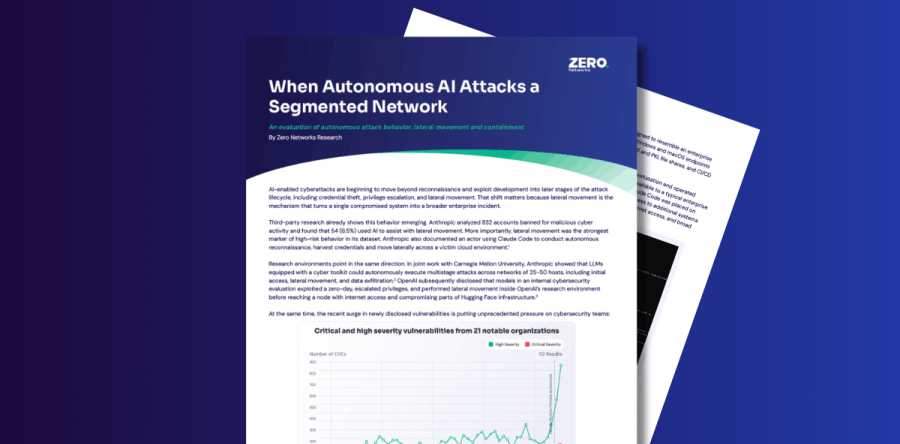
When Autonomous AI Attacks a Segmented Network

- Network Segmentation & Microsegmentation
October 09, 2026
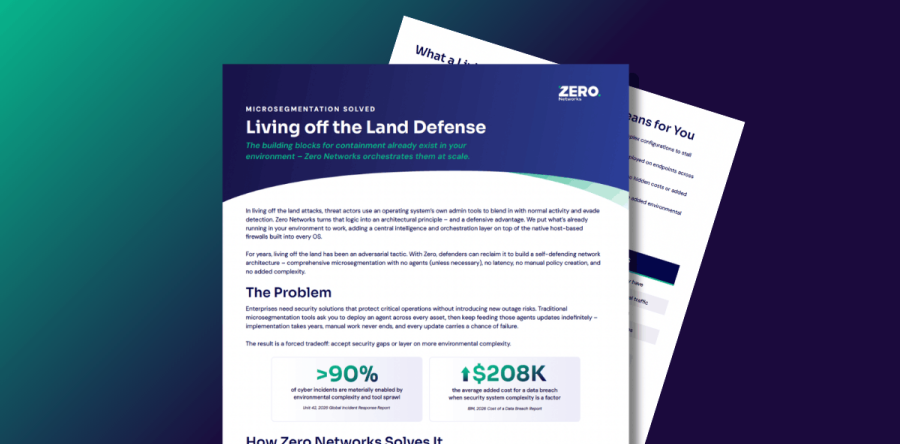
5 Real Reasons Why Microsegmentation Projects Fail—and How Zero Networks Solves Them
- Network Segmentation & Microsegmentation
AI vs Architecture: How to Win Against Machine-Speed Attacks

- Network Segmentation & Microsegmentation
September 23, 2026
Autonomous Microsegmentation 101: Why Gartner Says Automation is the Only Way to Contain Breaches on the Global Attack Surface
Trusted by


