Top 10 Lateral Movement Risks in Enterprise Networks (and What to Do About Them)
Published June 30, 2026

Mikella Marley Content Marketing Manager

Zero Networks' 2026 Lateral Movement Exposure Report analyzed 54 trillion activities across 312 enterprise environments to answer one question: how do breaches turn into business outages? In answer, the report uncovered a structural problem: organizations have built networks optimized for access and connectivity where containment is an afterthought.
We’ll break down the top 10 risks behind unauthorized lateral movement in enterprise networks, exploring what each one means, why it matters for cyber resilience, and how to strengthen your posture.
Key Answers
- How do attackers move laterally inside a network? The same protocols and trust relationships that keep business operations running – RDP, SMB, SSH, WinRM, RPC, cloud APIs, and orchestration platforms – are the pathways adversaries use to move laterally and turn a single compromised identity, workload, or laptop into a companywide outage. For example, 87% of servers accept internal RDP or SSH traffic, 78.7% are reachable over SMB or WinRM, and a single compromised host can reach 85% of internal systems in the first hop.
- Why does breach prevention alone fail to protect business continuity? Attackers move faster than defenders can respond. The fastest recorded breakout time in 2025 was 27 seconds, yet the average time to identify and contain a breach is 241 days. That 771,200:1 ratio means that by the time most organizations detect a compromise, the attacker has already moved. Breach prevention addresses the perimeter without limiting how far an attacker travels once inside. Containment structurally limits what a compromised asset can reach.
- How is AI changing the lateral movement threat landscape? With AI-driven lateral movement (AILM), adversaries use AI to accelerate the attack chain or weaponize overprivileged AI agents’ legitimate connections to pivot between systems. Roughly 80% of organizations have deployed AI agents, and two-thirds have no governance policies for them. These agents hold broad standing access across email, databases, cloud APIs, and code repositories. An attacker who compromises or manipulates an agent inherits its legitimate permissions; the agent's privilege becomes the attack path.
- How can enterprises block lateral movement inside their network without disrupting operations? The key is a closed-by-default architecture where administrative protocols are opened on demand rather than broadly exposed, access is governed by identity context and per-session authorization rather than standing permissions, and segmentation enforces least-privilege connectivity at the network layer. Just-in-time access and automated policy enforcement mean controls adapt to operational need rather than blocking legitimate connections.
The Risks That Enable Lateral Movement: Real-World Exposure and Benchmark Data
Lateral movement is the process attackers use to move from an initially compromised asset to additional systems, accounts, data stores, or control-plane infrastructure. In other words, lateral movement is how attackers convert a single compromise into enterprise-wide impact.
“Initial access is a security problem. Lateral movement is when it becomes a business continuity problem. Before lateral movement, you may have an intrusion. After lateral movement, you have downtime, ransomware propagation, data exposure, failed recovery, customer impact, and executives explaining why one compromised endpoint could reach systems it never should have touched.”
Dr. Chase Cunningham
These 10 risks represent the structural exposures responsible for lateral movement in enterprise environments.

1. Broad Internal Admin Protocol Exposure
Protocols like RDP, SMB, SSH, WinRM, and WMI are widely reachable across the internal environment. These protocols are foundational to Windows, Active Directory, and IT operations, making them critical for business continuity – and opening up lateral movement highways.
Over 70% of enterprise threat activity flows through SMB, RDP, WinRM, and RPC, meaning attackers rely on the same trusted pathways the business depends on to function. The scope of the problem is undeniable: 87% of monitored servers accept internal RDP or SSH traffic, and 78.7% are reachable over SMB or WinRM.
What to Do About It: Dynamically Close Admin Protocols
To mitigate exposure across protocols like RDP, SMB, SSH, WinRM, and WMI, admin protocols should be closed by default – only opened on demand with per-session authorization and MFA. Just-in-time access enforcement minimizes risk without disrupting critical workflows. Layer-7 inspection on east-west traffic, including RPC, SMB, LDAP, and DNS, ensures malicious activity is distinguished from routine administration.
2. Excessive Internal Reachability
Enterprise networks were built for access and connectivity, not containment. The result is that internal systems can communicate too broadly by default, giving attackers an expansive internal attack surface the moment they gain a foothold.
A single compromised host can reach 85% of internal systems on the first hop and effectively 100% on the second. A frequently neglected dimension is egress: most organizations block unsolicited inbound traffic but treat outbound traffic as inherently trustworthy, giving attackers a clear channel for command-and-control communication and data exfiltration over protocols like HTTPS and DNS.
The problem compounds in modern environments. Cloud platforms, Kubernetes clusters, AI agents, and hybrid infrastructure create dynamic communication patterns that frequently bypass static segmentation models, multiplying possible attack paths as environments grow.
What to Do About It: Enforce Least-Privilege Connectivity
Critical systems should be isolated by default, with administrative access tightly scoped and time-bound, and every communication path explicitly justified. User, server, cloud, Kubernetes, and agentic environments should be segmented by design, with critical assets explicitly isolated from user endpoints and egress filtering applied alongside inbound controls.
3. Excessive Privileged Access
Admin credentials can typically authenticate broadly across the environment with standing permissions that far exceed daily operational need. In fact, 99% of users, roles, and services hold excessive standing permissions, often unused for 60 days or more, and over 80% of attacks leverage stolen credentials at some stage.
Without proper identity segmentation – the practice of restricting access based on identity context and limiting the scope of what each identity can authenticate to – an attacker can take one compromised identity and leapfrog between systems.
What to Do About It: Apply Granular Identity-Based Access Controls
Just-in-time admin access, tiered administration, and per-system authorization limit what each identity can reach – not just where it can enter. Identity-context-aware east-west policies ensure a compromised credential operates within tightly scoped boundaries rather than across the entire environment it technically can authenticate to.
4. Overprivileged Service Accounts
Service accounts – non-human identities used by applications, services, and automation – are frequently overprivileged and are systematically under-monitored. Machine and service identities now outnumber human identities 109:1, yet only 2.6% of workload identity permissions are actually used, and 51% of workload identities are completely inactive.
In on-premises environments, service accounts often carry static passwords that never expire and are sometimes shared across multiple services. In cloud environments, a single overprivileged role can silently enable complete environment takeover without any additional exploits required.
What to Do About It: Apply Least Privilege to Every Machine Identity
Service accounts should be scoped to the minimum permissions their function requires, with regular credential rotation, usage monitoring, and source-binding so credentials only function from sanctioned workloads. This limits what a stolen service account credential can do, even if it is valid.
5. Legacy Authentication Paths
Outdated authentication mechanisms create exploitable trust paths that modern controls cannot reach. NTLM is the canonical example: 43.2% of observed internal authentication traffic in enterprise environments still uses it, and its design means an attacker who obtains a hashed credential from one machine can authenticate directly to another without recovering the plaintext password.
Older email protocols like POP3 and IMAP bypass MFA entirely while Cleartext protocols expose credentials to anyone with network visibility. According to Microsoft, more than 99% of password-spray attacks use legacy authentication protocols that bypass MFA – disabling legacy authentication in Entra ID alone reduces account compromise risk by 67%.
What to Do About It: Retire Legacy Protocols and Enforce Modern Authentication
Modern authentication standards like OAuth 2.1 and OIDC should replace legacy protocols across the environment, with MFA enforced on privileged internal access alongside perimeter authentication. Every legacy protocol left active is an authentication path that bypasses modern controls, leaving enterprises vulnerable to unauthorized lateral movement.
6. Exposed Control Plane Infrastructure
Active Directory, IAM platforms, backup systems, virtualization hypervisors, Kubernetes API servers, CI/CD controllers, and cloud management consoles are the operational brains of modern environments – and they’re often broadly reachable as segmentation of control-plane infrastructure remains inconsistent across enterprise environments.
When critical management systems are reachable from broad internal segments, a single compromised component gives attackers direct access to large portions of the enterprise. The stakes extend beyond access: if attackers reach backup infrastructure or orchestration systems, recovery operations themselves may fail.
What to Do About It: Isolate the Control Plane
Control-plane systems should sit in dedicated management zones with restricted admin paths and MFA-gated access. Continuous monitoring of access to Active Directory, IAM, hypervisors, backup infrastructure, and CI/CD systems provides early warning of targeting before recovery options are compromised.
7. Internal Vulnerability Pivoting
Even organizations that diligently patch internet-facing systems frequently overlook internal ones – and attackers exploit that gap directly. Sensitive internal protocols remain broadly reachable across both server and client populations; unpatched or misconfigured internal services mean an attacker with a foothold can scan for a vulnerable service and exploit it without needing credentials or social engineering.
Meanwhile, AI-powered vulnerability research is changing the economics of exploitation. Models like Anthropic's Mythos have demonstrated the ability to identify exploitable weaknesses and develop attack paths with limited human involvement, compressing the window between patch release and exploitation beyond what most patch cycles can accommodate.
What to Do About It: Segment Vulnerable Assets
Internal patch SLAs should apply to server and client populations, not just internet-facing systems. Where patching is delayed, granular segmentation around vulnerable assets limits their exploitability. Attack-path prioritization should account for internal reachability and legacy protocol restriction, not CVSS score alone.
8. Lack of East-West Visibility
Security teams cannot contain what they cannot see. Most organizations have reasonable perimeter logging, but logging and auditing of access between internal workloads, services, and accounts is inconsistent, meaning adversaries can exploit access and expand reach without triggering an alert.
Many organizations lack identity-attributed east-west authentication visibility, and full authenticated traffic logging between workloads remains inconsistent. Without it, misconfigurations go unidentified, dwell time extends, and security teams cannot reconstruct attack paths when incidents occur.
What to Do About It: Identity-Attributed Traffic Logs
East-west visibility requires identity-attributed traffic logs tied to specific identities rather than IP addresses or ports, combined with alerting on unusual internal movement and real-time path analytics – giving security teams the tools to act before lateral movement reaches critical systems.
9. Single Endpoint to Critical Asset Reachability
One user endpoint can be leveraged to reach high-value assets directly. While the risk of excessive internal reachability describes broad system-to-system communication, this one explores a dangerous special case: how often a routine workstation sits one hop away from crown-jewel infrastructure like domain controllers, backup systems, ERP platforms, and cloud management consoles.
Attacks start wherever adversaries can gain access – that’s rarely on critical systems. Business impact grows when that initial foothold has a direct, unbroken path to the systems that matter most: 12.2% of organizations demonstrate direct user-to-server administrative pathways, sensitive administrative services remain broadly reachable from internal environments, and endpoint-to-server administrative connectivity is common across enterprise networks.
What to Do About It: Close Direct User-to-Critical-Asset Pathways
Multi-stage access controls between user and server tiers, segmentation by sensitivity tier, and critical assets explicitly isolated from user endpoints ensure a compromised endpoint cannot directly reach crown jewels.
10. Poor Containment Readiness
Attackers often move freely for months before enterprises detect the breach. While attackers begin moving laterally in as little as 27 seconds, it takes an average of 241 days to identify and contain a breach – that’s a breakout-to-containment ratio of 771,200:1.
What’s worse, many organizations lack the ability to rapidly revoke risky access paths without disrupting operations as containment readiness remains operationally immature across enterprise environments.
What to Do About It: Build Containment into the Network Architecture
Fast isolation playbooks, identity kill-switch capability, and controlled segmentation response modes that can quarantine a compromised host without halting surrounding operations are the foundations of containment readiness. When these capabilities are built into the network architecture, organizations remove the tradeoff between stopping the spread of a breach and keeping the business running.
How to Assess Your Lateral Movement Posture
The ten risks uncovered in the 2026 Lateral Movement Exposure Report map to a single underlying question: how far can an attacker travel once inside your environment? To find the answer, security leaders should assess their readiness across six dimensions:
- Identity Security: Can you deploy least privilege across humans, machines and agents?
- Network Segmentation: Can systems communicate only where required?
- Administrative Controls: Are admin pathways tightly restricted?
- Control Plane Protection: Are critical management systems isolated?
- Detection & Response: Can suspicious movement be detected and contained quickly?
- Operational Resilience: Can the network continue operating to support the business even during an active attack?
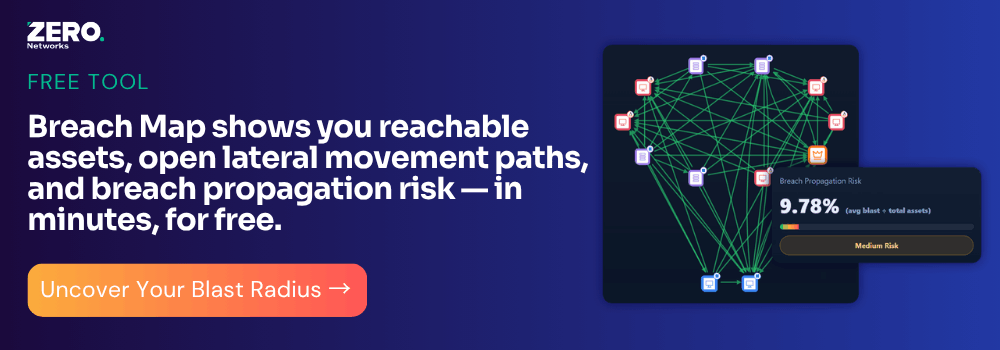
The ultimate goal of lateral movement posture management is to minimize the blast radius of any attack and safeguard business continuity. Knowing what your network looks like to an attacker is a critical first step in strengthening cyber resilience and architecting for containment.
Proactively Stop Lateral Movement with Zero Networks
Zero Networks’ layered approach to lateral movement prevention closes long-standing security gaps and addresses emerging risks without creating operational complexity: automated, identity-driven microsegmentation closes the protocol exposure, reachability gaps, and privilege sprawl that enable lateral movement in modern environments, while deterministic, human-on-the-loop automation streamlines policy creation and enforcement without risking disruption.
For a firsthand look at how Zero Networks makes threat containment an architectural feature, request a demo.