Incident Response vs. Breach Containment: Modernizing Cyber Resilience and Recovery
Published August 31, 2026

Mikella Marley Content Marketing Manager

It takes an average of 247 days to identify and contain a breach, yet attackers typically begin moving laterally in less than 30 minutes. Cyber incident response has long relied on the assumption that defenders have time to observe anomalous behavior, investigate it, and coordinate containment before business impact escalates. The massive delta between attack speed and breach containment proves that assumption no longer holds – and the disparity is only growing wider with the rise of AI-driven attacks.
For enterprises focused on strengthening cyber resilience, the answer isn’t faster detection or more automated response. The only reliable advantage for defenders is to rethink incident response, stepping out of the endless cycle of chasing attacks to instead prioritize proactive containment.
We’ll walk through how incident response is changing in the AI era, why a containment architecture is key to accelerating cyber incident recovery and strengthening resilience, and share a practical framework for making automated breach containment a built-in feature of the network.
Key Answers
- How can security teams quickly isolate infected systems without shutting down the whole network? Implement identity-based microsegmentation, so the blast radius of a breach is proactively constrained, and threats remain isolated to the initial point of compromise. When lateral movement and privilege escalation are blocked by the network architecture, breaches hit an immediate dead end.
- What's the difference between incident response and breach containment? Incident response (IR) is the structured process teams follow once a cyber incident is identified; breach containment refers specifically to limiting the spread of an attack across the network. In traditional IR plans, containment is typically treated as a sequential step in the response chain, but when containment is enforced architecturally (for example, through microsegmentation and identity-based access controls), it operates independently of other steps, removing the dependency on detection and response.
- How can enterprises strengthen cyber resilience with an incident response plan? A cyber incident response plan strengthens cyber resilience when it treats containment as a precondition rather than a reactive step in a response chain. Rather than relying solely on a workflow that is only initiated once a breach is detected, proactive containment makes cyber resilience the default posture.
What Is Cyber Incident Response?
Incident response (IR) in cybersecurity is the structured process organizations use to detect, contain, and recover from cyber incidents. Traditionally, incident response unfolds in phases:
- Preparation: Establish policies, roles, training, and technical capabilities
- Detection & Analysis: Identify the presence and scope of malicious activity
- Containment: Stop the spread of the threat across the network
- Eradication & Recovery: Remove the threat and restore normal operations
- Post-Incident Activity: Analyze and learn from the incident; improve processes and security measures
This sequence has been central to enterprise security operations for decades, all the while carrying a built-in assumption: that incident detection is a necessary prerequisite for containment and recovery.
Breach Containment vs Cyber Recovery vs IR
Incident response, breach containment, and cyber recovery are distinct concepts that connect to a central theme:
|
Term |
What It Covers |
When It Traditionally Happens |
|---|---|---|
|
Incident Response (IR) |
The coordinated process of detecting, investigating, and responding to a cybersecurity incident |
Begins once an incident is identified; runs through recovery |
|
Breach Containment |
Limiting how far an attacker can move and what they can reach once inside the network to keep an incident isolated |
Traditionally treated as an isolated phase within IR that occurs after detection |
|
Cyber Recovery |
Restoring systems, data, and operations to normal following an incident |
The final phase of IR, dependent on the success of every other step in the sequence |
In other words, incident response describes the collective sequence an enterprise kicks off after identifying a security breach; breach containment and cyber recovery are typically viewed as steps within the broader IR umbrella. But viewed this way, the traditional IR model is a relay: detection has to work before containment can start, and containment has to be executed before recovery can begin. Each phase waits on the one before it. In the Frontier AI era, that approach is too brittle and too slow to reliably strengthen cyber resilience.
Incident Response Challenges in the AI Era
Standard incident response is a chain of steps – each of which carries its own risk of failure. For the chain to work, every step has to go right; in the real world, that rarely happens.
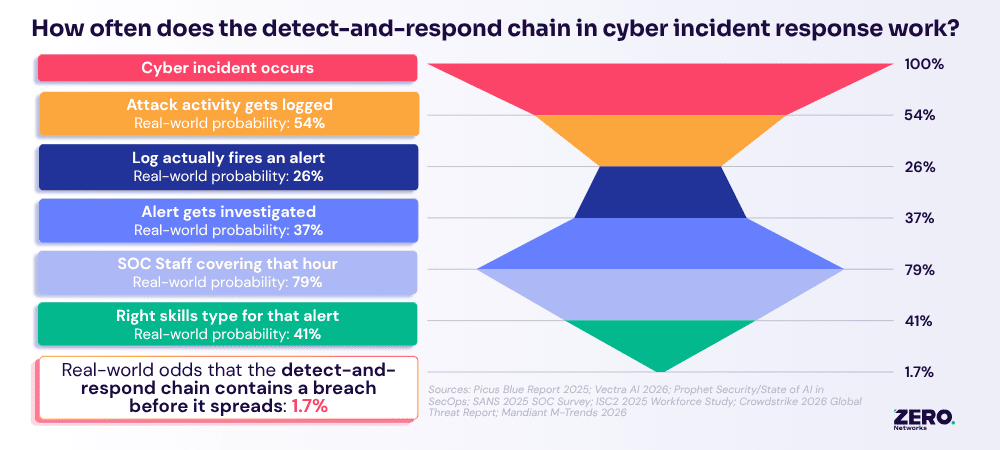
In an era of AI-driven attacks, the failure points that have always existed in traditional IR playbooks are more apparent – and more risky – than ever. A few uniquely modern threat realities are driving the shift away from traditional incident response:
- Attack speed outpaces coordinated response workflows: Attackers begin moving laterally in as little as 27 seconds, with average breakout time now sitting at 29 minutes. Yet it still takes defenders an average of 183 days to identify a breach – and another 64 to contain it. Meanwhile, attackers now move from initial access to data exfiltration in as little as 72 minutes. The mismatch between AI-enabled attack speed and traditional threat response plans leaves enterprises vulnerable.
- Attackers blend in with normal activity to evade detection: More than 80% of cyber incidents are malware-free attacks as adversaries increasingly abuse legitimate tools, systems, files, or applications to blend in with legitimate traffic while carrying out a compromise. In fact, more than 70% of enterprise threat activity flows through just four admin protocols. As widespread AI adoption continues to climb and attackers weaponize agentic AI security gaps, organizations that still rely heavily on detection to kick off IR face an uphill battle in identifying exploits at all – let alone stopping them before they impact business operations.
- Threat actors are targeting backup infrastructure and other core systems to drive business disruption: The average cost of downtime triggered by cyber incidents jumped to $15,000 per minute in 2026, according to Oxford Economics – a price tag attackers know enterprises don’t have the appetite to absorb. Because of that, adversaries are specifically targeting back up technologies, virtualization management planes, and other parts of trusted service infrastructure to intentionally disrupt operations and make it harder for organizations to recover from a cyber incident.
The rising speed, stealth, and persistence of AI-driven attacks forces defenders relying on inherently reactive incident response plans to intentionally trigger downtime in order to isolate breaches. According to Mandiant’s 2026 M-Trends Report, security teams often have to preemptively disconnect critical systems to halt the spread of an attack, effectively triggering a self-induced outage to avoid total compromise.
Organizational survivability predicated upon Endpoint Detection and Response (EDR) or traditional backup restoration at the endpoint layer are no longer sufficient recovery models. Instead, a model focused on resilience, which seeks to address the primary objectives attackers pursue, represents the best chance for organizations to keep pace with the rapid evolution of ransomware operators.”
- Mandiant M-Trends Report, 2026
Cyber Resilience Strategy for Real-Time Threat Containment: A Modern Framework
Reactive IR playbooks are a losing strategy against modern attackers that weaponize AI to disrupt every stage of the traditional breach response flow. To strengthen cyber resilience – ensuring the organization is prepared to absorb a breach and constrain its impact before an incident occurs – defenders need to prioritize built-in containment over reactive response.
Proactively Isolate Every Asset with Microsegmentation
Comprehensive microsegmentation isolates every network asset inside its own security zone, keeping the blast radius of a breach constrained to the initial point of compromise automatically. This means security teams don’t have to race to disconnect critical systems when a breach is identified, triggering downtime in the process – instead, threats are contained in real time even if no alert fires, making detection speed irrelevant and recovery processes far simpler.
Eliminate Always-On Access with Granular Identity-Based Controls
Identity weaknesses play a material role in 90% of cyberattacks, with standing access and excessive internal trust effectively handing attackers lateral movement fast-lanes. Granular access controls should be tied to the identity of users, devices, or applications and restricted to pre-approved assets and logon types. When identity governs access inside a segmented network, security teams can effectively prevent unauthorized lateral movement that would otherwise blend in with legitimate activity.
Enforce Just-in-Time (JIT) MFA on Privileged Pathways
Even an admin account that requires privileged access to complete regular operations shouldn’t hold elevated permissions indefinitely. Instead, implement network-layer MFA on sensitive protocols, systems, and activities, granting just-in-time access only after an identity with a confirmed business need completes verification – and only for as long as necessary. After the necessary window closes, automatically revoke elevated permissions to eliminate the persistent privileged access that allows attacks to escalate quickly without triggering alarms.
Dynamically Adapt Protection with a Deterministic Policy Engine
Just as modern environments – and the threats targeting them – are too dynamic for rigid IR playbooks, they’re too fluid for static policies. To ensure real-time containment happens automatically, policies must adapt as the network changes. By maintaining always-current network visibility and feeding up-to-date insights into a deterministic automation engine, enterprises can keep enforcement current and tied to observed business need without taking on constant rule maintenance and operational debt.
Strengthen Cyber Resilience and Automate Containment with Zero Networks
Cyber resilience isn’t just about bouncing back from an attack – it’s about staying operational when an incident occurs. By building a closed-by-default architecture, organizations can regain a defensive advantage, proactively containing security breaches regardless of how quickly detection and response workflows are initiated.
Zero Networks’ automated, identity-driven microsegmentation gives enterprises a modern solution for cyber incident recovery and resilience by combining comprehensive network segmentation, deterministic automation, identity-based access controls, and network-layer MFA for just-in-time access.
Decoupling breach containment from detection rewrites the traditional IR playbook. When containment happens automatically, cyber incident recovery no longer sits at the finish line of a reactive relay race; with Zero, containment is a built-in architectural feature, so resilience is the default posture.
See for yourself how Zero Networks stops breaches automatically, revolutionizing incident response to strengthen cyber resilience – request a demo.