AI-Ready Infrastructure: How to Assess Enterprise AI Readiness and Resilience
Published October 30, 2026

Mikella Marley Content Marketing Manager

Nearly 90% of organizations now use AI in at least one business function. Meanwhile, security breaches involving AI tools have risen 61% year over year, according to IBM’s 2026 Cost of a Data Breach Report.
Beyond targeting the vulnerabilities created by enterprise AI adoption, attackers are also using AI to execute attacks faster and more effectively. This double-edged sword of AI risk forces security teams to ask two connected questions: how can we protect the AI in our environment from exploitation, and how can we prevent AI-powered attacks from spreading?
The solution is building an AI-ready network, designed to enforce granular controls for internal AI tools and stop AI-speed attacks in real time. We’ll share a framework for benchmarking AI readiness and best practices for strengthening AI resilience at the architectural level.
Key Answers
- What is AI resilience? AI resilience is an organization’s ability to withstand and continue operating through an AI-related compromise, whether that’s an AI-accelerated attack or exploitation of internal AI tools and agents. Resilience against AI threats depends on a network architecture designed to contain compromises at the point of entry, making the speed of an attack irrelevant.
- What are the pillars of an AI-ready network architecture? An AI-ready architecture requires a closed-by-default network that makes unauthorized lateral movement impossible, identity-based access controls, a deterministic enforcement layer, isolated model infrastructure, and comprehensive, real-time network visibility. Together, these pillars enable enterprises to adopt AI safely while containing AI-powered attacks.
- How can enterprises assess their AI readiness? Enterprises can assess their AI readiness by benchmarking their network architecture across dimensions like containment, policy management, identity governance, and AI exposure and operational load. For a customized report that scores AI readiness across a five-stage maturity framework, surfaces the most urgent AI exposures, and provides next steps for strengthening resilience, take Zero Networks’ AI Readiness Assessment.
What Is AI Readiness?
AI readiness is an organization’s capacity to safely adopt, scale, and govern AI tools and agents while also protecting against AI-driven cyber threats.
Most AI readiness assessments encompass broad pillars, like business strategy, data foundations, culture, technical infrastructure, and model management. While these assessments help organizations effectively map a high-level AI strategy, they’re often too broad to measure real exposure.
An organization could score well across strategy, data governance, and AI usage policy dimensions while the network still allows widespread AI agent access and gives AI-enabled attackers a straight path from initial foothold to critical assets. In other words, aggregate AI readiness scores can give organizations a false sense of security without properly weighting the factors that actually determine AI resilience: how much access internal AI tools inherit and how far an AI-powered attack can travel.
AI Resilience: What It Is and How Security Leaders Can Measure It
In cybersecurity, AI resilience is an organization’s ability to continue operating when an AI-related compromise occurs – whether that’s an internal AI tool being exploited or an attacker weaponizing advanced AI models to gain access and move laterally.
While AI readiness refers to a proactive posture, AI resilience is a measure of how that posture holds up under pressure. To reliably predict AI resilience, organizations need to benchmark their ability to address both sides of the AI threat landscape.
The AI Attack Surface
Every AI tool, agent, and workflow adopted into enterprise environments quietly expands an evolving AI attack surface if not properly governed. Shadow AI usage creates connectivity that nobody approved, reviewed, or is watching; exposed model infrastructure leaves enterprises vulnerable to model tampering and data extraction; and AI agents inherit excessive access and autonomy across a broad range of systems. In fact, less than a third of organizations have extended Zero Trust architecture to include non-human identities like AI agents.
AI as an Attack Accelerant
Threat actors are using AI to compress the attack lifecycle, closing the window between initial access and business disruption. Frontier models can discover and exploit vulnerabilities at machine speed and scale, and AI-driven lateral movement allows attackers to pivot from an initial foothold in as little as 27 seconds. Zero Networks’ 2026 Lateral Movement Exposure Report found that a single compromised host exposes 85% of internal systems – attackers are now weaponizing that exposure faster than any detect-and-respond workflow can match.
Measuring Resilience Against AI Threats: The Shared Foundation
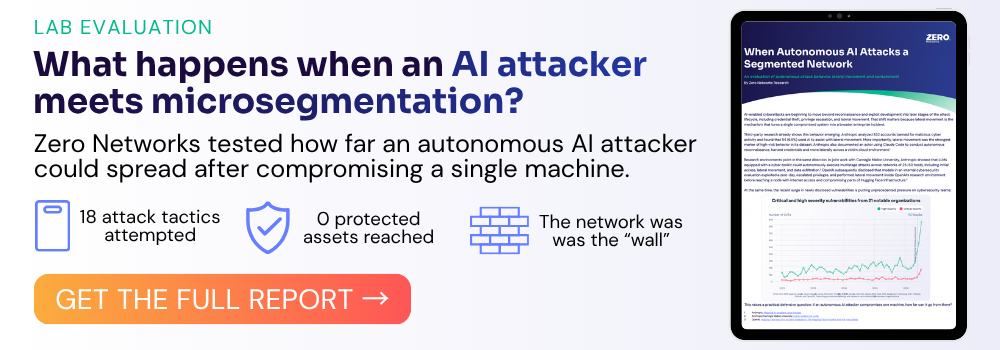
AI-powered cyberattacks and threats exploiting AI vulnerabilities rely on the same weakness: open internal pathways. An AI-accelerated attacker moves laterally through existing communication paths, just faster; a rogue AI agent leverages broad standing access to reach critical systems without raising alarms.
This means that the most dependable measure of AI readiness and resilience is a closed-by-default architecture that restricts internal reachability by design and enforces granular identity-based access controls for users, devices, applications, and AI agents. It doesn’t matter how fast attackers move when the pathways they rely on don’t exist.
5 Pillars of AI-Ready Infrastructure
Many teams focus on performance when designing an AI-ready infrastructure, measuring success based on factors like GPU capacity, storage, and high-bandwidth networking that keeps AI workloads running smoothly. But while performance makes AI adoption possible, architecture is what makes it safe.
From a security perspective, an AI-ready infrastructure should be built on five core pillars:
Closed-by-Default Network Architecture
Lateral movement pathways should be closed proactively with comprehensive microsegmentation, so new AI tools, agents, and workflows are adopted inside a network that's already hardened. When a breach occurs, microsegmentation keeps it contained to the initial point of compromise so the speed of an attack becomes irrelevant.
Curious how far an exploited agent or AI-driven attacker could move in your network today? Get an interactive visual map of your attack surface in minutes, for free with Zero Networks’ Breach Map tool →
Identity-Governed Access for Every Connection
Enforce least-privilege access policies for every identity – whether human, machine, or AI agent. Narrowly scope AI agent access to what’s operationally necessary and implement network-layer MFA to require just-in-time verification for privileged access, ensuring stolen credentials or hijacked sessions can’t be leveraged by AI-powered attackers as a fast-pass to critical assets.
Adaptive, Deterministic Guardrails
Modern networks evolve constantly; when new AI is adopted internally, any lag in policy creation leaves security gaps that AI-driven attackers can exploit. Deterministic, human-on-the-loop automation builds rules based on real network behavior and adapts enforcement as the environment changes, closing configuration gaps before they create a window of opportunity for attackers.
Isolated Model Infrastructure
Combining network segmentation and identity segmentation allows enterprises to close risky LLM exposure, isolating model infrastructure so it’s only accessible to explicitly authorized systems and identities. Locking down the access paths attackers rely on to tamper with or extract data from a model means security teams aren’t required to fully understand the model’s internal behavior in order to protect it.
Comprehensive, Real-Time Visibility
AI adoption has outpaced governance in many enterprises. Without full visibility into which cloud AI services users are accessing, how developers are deploying AI, or which third-party software has embedded autonomous workflows, security teams can’t effectively strengthen AI resilience. An always-current network map delivers visibility into every AI tool, agent, and integration in the environment, providing the insights security teams need to block unsanctioned AI services by default and constrain internal AI access.
AI Readiness Assessment Framework: Benchmarking Architectural Resilience
Assessing a network’s AI readiness requires asking specific questions that map to the core dimensions of resilience. Use these questions to gauge where your architecture sits on the AI readiness spectrum:
| Dimension | Key Questions to Assess Readiness | Why They Matter |
|---|---|---|
| Containment architecture |
|
Segmentation granularity sets the ceiling on how far a compromised AI tool or AI-powered attacker can travel. The more open the internal network, the more access every agent inherits and every exploit can use. |
| Policy management |
|
AI adoption changes the environment faster than periodic change cycles can match, and AI-driven attacks find the gaps static policy leaves behind. |
| Identity governance |
|
Agents with excessive access create a vulnerable, often hidden attack vector. Network-layer MFA stops attackers using stolen credentials from reaching privileged systems, regardless of how fast they move. |
| AI exposure and operational load |
|
Broad AI adoption multiplies the identities and connections to govern. Heavy manual effort signals an architecture that can’t keep pace with either side of the AI threat landscape. |
Using insights from these key questions, organizations can map their AI readiness to a five-stage maturity framework, uncovering which AI-related exposures pose the most urgent risk and establishing next steps to strengthen AI resilience.
AI Readiness Stages
| Stage | Typical Controls | Internal AI Exposure | AI-Powered Attack Exposure |
|---|---|---|---|
| Initial | Perimeter firewalls; flat internal network | Every AI tool and agent, sanctioned or not, has free run of the environment | A single compromised endpoint gives attackers direct access to critical resources |
| Developing | VLANs, ACLs, internal firewalls | Zones exist, but AI agents have no identity constraints and shadow AI usage remains uncontrolled | AI-driven exploits pivot between zones through misconfigurations and permissive inter-VLAN rules at machine speed |
| Intermediate | Application or workload ringfencing | AI agents inside each ring are trusted implicitly, governed by network position rather than identity | Once inside a ring, AI-enabled attacks escalate at machine speed |
| Advanced | Per-asset, host-level controls | Without identity-based access controls, AI agents inherit overly permissive policies | AI-driven attacks that blend in with normal activity outmaneuver static configuration gaps |
| Holistic | Identity-based, MFA-enforced microsegmentation of all assets and identities | AI is a governed, visible participant in the environment | AI-accelerated exploits hit an immediate dead end |
For security teams that want a defensible assessment of their network’s AI resilience, Zero Networks’ AI Readiness Assessment delivers a tailored report in less than five minutes, including customized next steps for defending against AI-driven attacks and securing AI tools and agents in your environment.
Build an AI-Ready Architecture with Zero Networks
Assessing AI readiness and resilience requires benchmarking maturity across the capabilities that truly protect business continuity.
Zero Networks contains risk by design, enabling enterprises to accelerate AI innovation without losing control. Identity-based microsegmentation proactively contains attacks – human or AI-driven – while AI Segmentation extends comprehensive visibility and control to every AI tool, agent, and model in the environment.
See how you can build AI resilience into your network architecture with Zero – request a demo.